digital marketing
SEO vs Google Ads: The Ultimate Guide to Choosing the Right Strategy
July 31, 2026 · By Aysha Rizwana
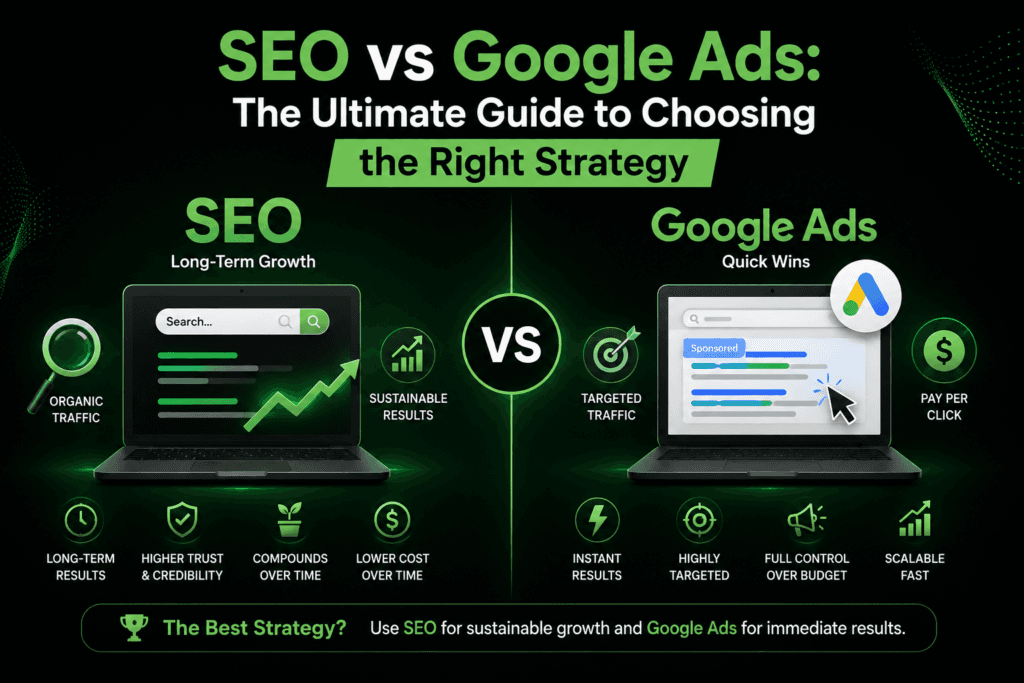
Two business owners launching identical online stores on the same day.
One pours their budget into Google Ads. By lunchtime, they're on page one. By evening, they've made their first sale.
The other invests in SEO. A week goes by — nothing happens. A month goes by — still barely a ripple.
Six months later? The Ads-only store is still paying for every single visitor, watching their margins shrink with every click. The SEO-first store is now pulling in consistent, free traffic every single day — and it's still growing.
So which one made the smarter move?
Trick question. The real answer is: it depends entirely on what you need right now — and the smartest marketers know exactly when to use each one, and when to use both at once.
This guide breaks down the SEO vs Google Ads debate in plain terms, with real numbers to back it up. By the end, you'll know exactly which strategy fits your goals, your budget, and your timeline — no guesswork required.
What Is SEO, Really?
Search Engine Optimization (SEO) is the process of improving your website so it ranks organically — meaning unpaid — in search engine results. It involves optimizing content, site structure, keywords, backlinks, and technical performance so Google (and other search engines) sees your site as relevant and trustworthy.
Think of SEO as building a house. It takes time, effort, and the right foundation — but once it's built, it's yours. No one can evict you just because you stopped paying rent.
What Is Google Ads, Really?
Google Ads is a pay-per-click (PPC) advertising platform where you bid on keywords to show your ads at the top of search results, instantly, in exchange for a fee every time someone clicks.
Think of Google Ads as renting an apartment. You get to move in immediately, and the view might be incredible — but the moment you stop paying rent, you're out, and someone else takes your spot.
The Head-to-Head Comparison
Let's put both strategies side by side so you can see exactly where each one wins. This table alone answers most of the SEO vs Google Ads questions beginners have.
| Factor | SEO | Google Ads |
|---|---|---|
| Speed of Results | Slow (3–6+ months) | Instant (within hours) |
| Cost Structure | Upfront time/effort investment, lower long-term cost | Pay-per-click (PPC), ongoing cost forever |
| Longevity | Long-term, compounds over time | Stops the moment you stop paying |
| Trust & Credibility | Higher — users trust organic results more | Lower — many users skip ads entirely |
| Control | Less predictable, algorithm-dependent | Highly controllable (budget, targeting, timing) |
| Scalability | Limited by content and authority growth speed | Instantly scalable with budget increases |
| Best For | Long-term brand building and sustainable traffic | Quick wins, product launches, and time-sensitive offers |
| Skill Required | Content, technical SEO, and link building | Campaign structuring, bidding strategy, and ad copywriting |
| Risk if Budget Stops | Traffic remains and may decline gradually | Traffic drops to zero almost immediately |
The Numbers Don't Lie: SEO vs Google Ads Traffic Over Time
Here's where the real difference becomes obvious. Let's say two businesses each start their strategy today — one running Google Ads for 6 months, the other investing in SEO consistently for a year. The chart below makes the SEO vs Google Ads trade-off impossible to ignore.
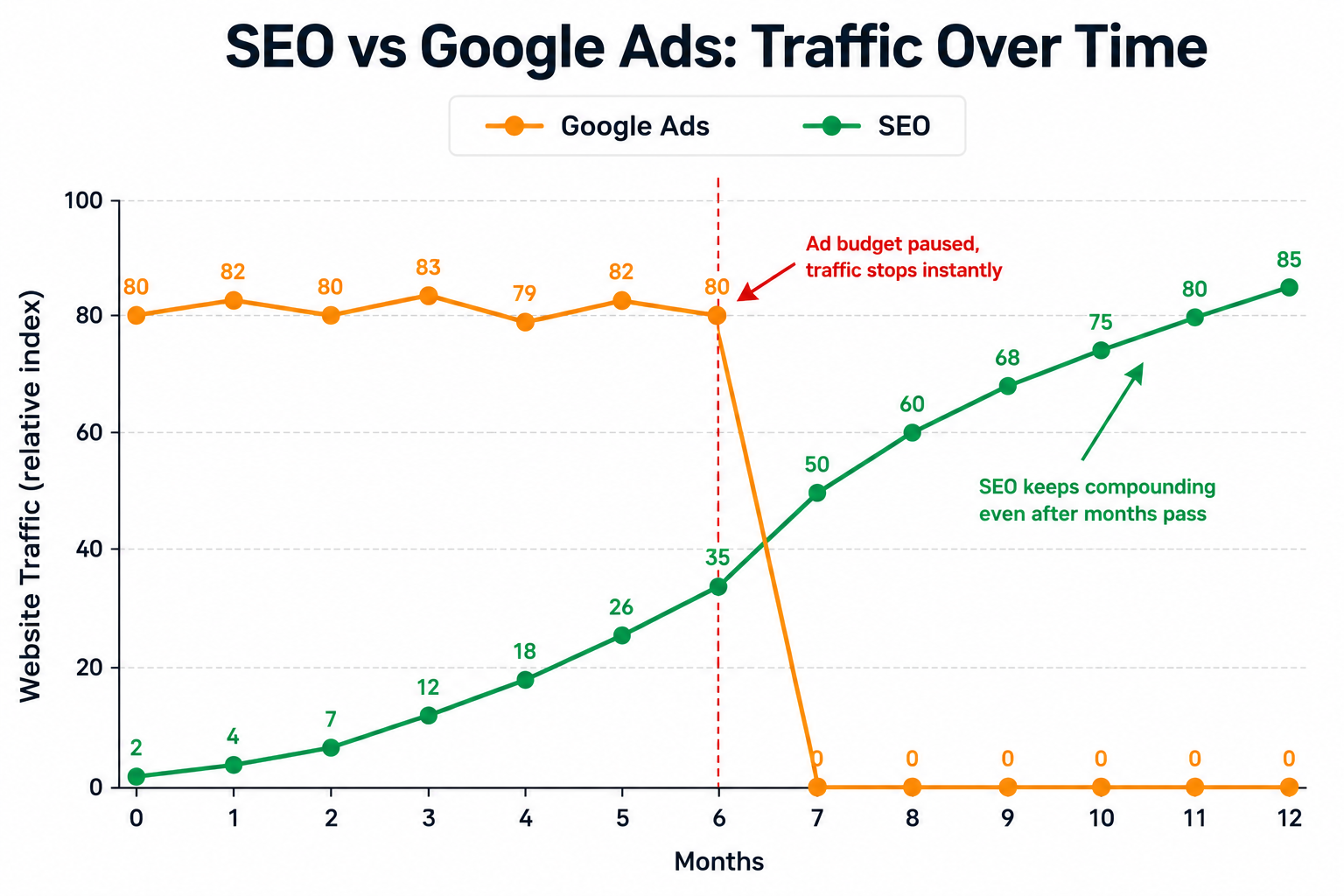
Notice what happens:
- Google Ads delivers strong, steady traffic — but the second the budget is paused (month 6 in this example), traffic collapses to zero almost instantly.
- Although SEO begins excruciatingly slowly and frequently feels like it's "not working" in the initial months, it continues to compound and doesn't go away when you stop actively allocating new funds.
This is the single biggest misunderstanding freshers and business owners have about these two strategies: SEO isn't slower because it's worse — it's slower because it's building something that lasts.
The Cost Reality: What You're Actually Paying For in SEO vs Google Ads
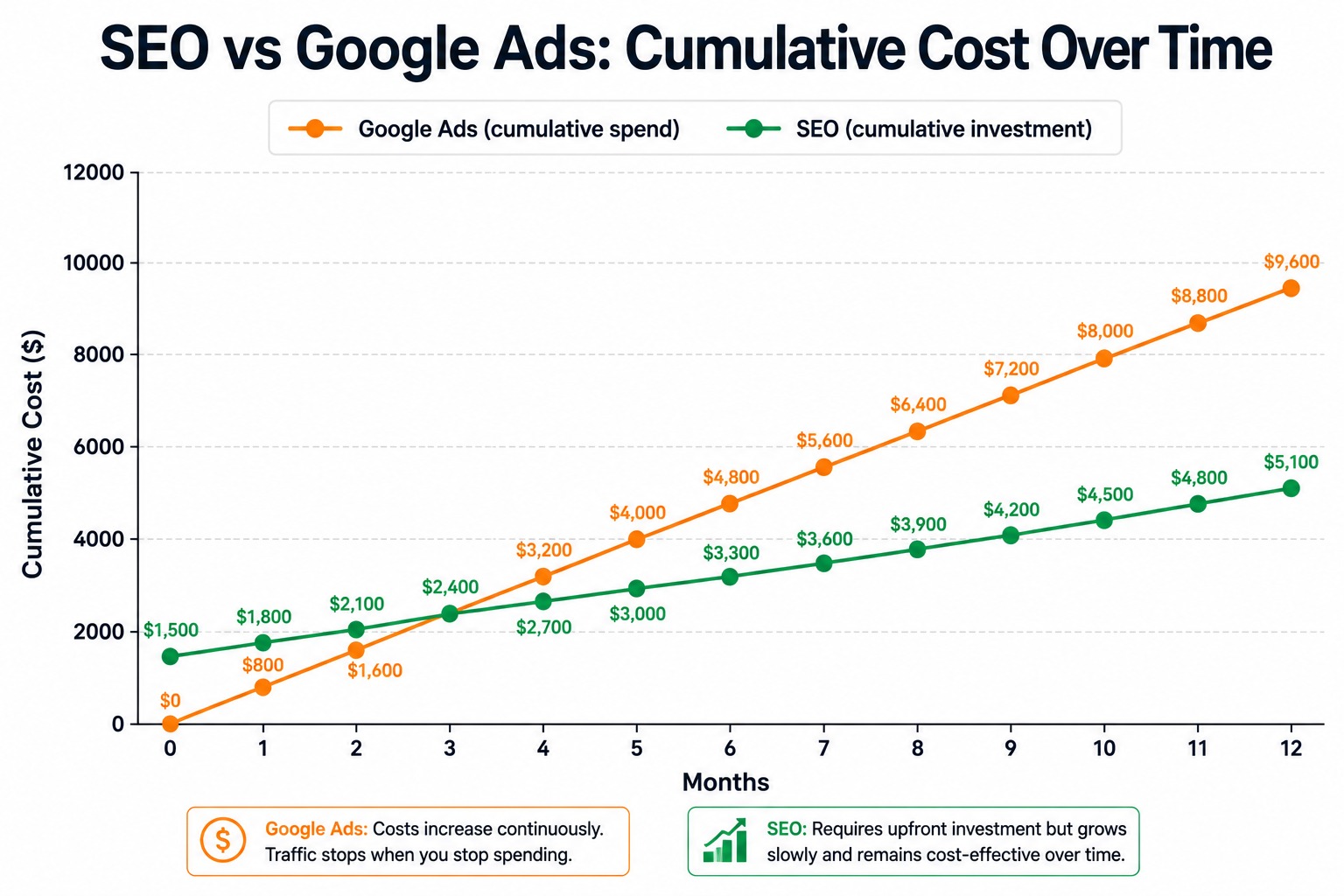
Google Ads costs scale linearly — the more traffic you want, the more you pay, every single month, forever. SEO typically requires a heavier upfront investment (content creation, technical fixes, link building), but the ongoing cost to maintain that traffic is significantly lower once you've built authority.
The catch: SEO's low ongoing cost only kicks in after the slow build-up phase. If your business can't survive 3-6 months without traffic, SEO alone isn't the right first move.
When You Should Choose SEO
If your priority in the SEO vs Google Ads decision is long-term, sustainable growth, these signs point clearly toward SEO:
- You're playing the long game and want sustainable, compounding traffic
- Your budget is limited and you can invest time instead of ad spend
- You're building a brand, not just chasing quick sales
- Your industry has high-intent, evergreen searches (e.g., "best CRM software," "how to fix a leaky faucet")
- You want to build trust and authority that ads simply can't buy
When You Should Choose Google Ads
On the other side of the SEO vs Google Ads equation, these situations call for paid search instead:
- You need traffic immediately — product launch, event, time-sensitive promotion
- You're testing a new offer and need fast data on what converts
- You're in a highly competitive niche where ranking organically could take years
- You have budget to spend and want precise control over targeting, timing, and audience
- You want to appear for keywords your SEO hasn't ranked for yet
Why the Smartest Marketers Don't Choose — They Combine Both
Here's the secret most beginner guides don't tell you: SEO and Google Ads aren't rivals — they're teammates.
- Use Google Ads to generate immediate traffic and validate which keywords/offers actually convert.
- Feed those insights into your SEO content strategy, doubling down on what you already know works.
- As your SEO rankings grow, gradually shift ad budget away from keywords you now rank for organically, and reinvest it into new, untapped opportunities.
- Run both simultaneously during high-stakes periods (product launches, sales, seasonal campaigns) to dominate the search results page — appearing in both the ad slot and the organic listing builds massive trust.
This hybrid approach is exactly how mature, high-growth businesses operate — they never rely on just one channel.
Quick Decision Table: Which One Should You Start With?
Use this table to settle the SEO vs Google Ads question for your specific situation in seconds.
| Your Situation | Recommended Starting Point |
|---|---|
| Brand new business, tight budget, can wait 3–6 months | SEO |
| Need sales this week, have ad budget available | Google Ads |
| Launching a new product today | Google Ads (short-term) + SEO (long-term) |
| Established brand wanting to reduce ad spend | SEO (redirect budget gradually) |
| Highly competitive, saturated industry | Google Ads first, SEO in parallel |
| Local service business (plumber, salon, clinic) | SEO (Google Business Profile) + Local Ads |
Final Takeaway
SEO and Google Ads aren't competing philosophies — they're two different tools solving two different problems: one buys you time, the other builds your future.
Understanding the SEO vs Google Ads trade-off is really about understanding your own timeline and budget, not picking a "winner."
If you need traffic today, Google Ads wins. SEO is the best option if you're creating something that should continue to draw visitors in five years. And if you're serious about long-term growth, the real answer isn't "SEO vs Google Ads" at all — it's "SEO and Google Ads, used strategically, at the right time."
Frequently Asked Questions (FAQ)
Which is better for beginners — SEO or Google Ads?
It depends on your budget and patience. If you have more time than money, start with SEO. If you have budget but need quick validation and sales, start with Google Ads. Many businesses eventually use both, so the SEO vs Google Ads choice isn't always permanent.
How much does Google Ads cost per click?
Cost-per-click (CPC) varies wildly by industry and keyword competitiveness — anywhere from a few cents to $50+ for highly competitive B2B keywords. It's best to start with a small test budget and scale based on results.
How long does it take for SEO to provide results?
Most websites start seeing measurable organic traffic growth within 3-6 months, with significant results typically taking 6-12 months, depending on competition, content quality, and technical site health.
If I stop paying for Google Ads, does all my traffic disappear?
Yes, almost immediately. Google Ads traffic is directly tied to active spend — once your campaigns stop running, that traffic source stops too, unlike SEO which can continue generating traffic long after the initial work is done.
Can small businesses compete with big brands using SEO?
Yes, especially with local SEO and long-tail, niche-specific keywords where big brands often don't focus their content efforts. Ranking for a highly specific, less competitive search term is often much easier than ranking for broad, high-competition keywords.

Author
Aysha Rizwana
Digital Marketing Executive cum Trainer
* Join Techoriz
Ready to master digital marketing?
Learn with Kerala's first ISO-certified agency-based digital marketing academy. Get expert training, live projects, and 95% placement support.
Keep reading
Related Posts
 digital marketing
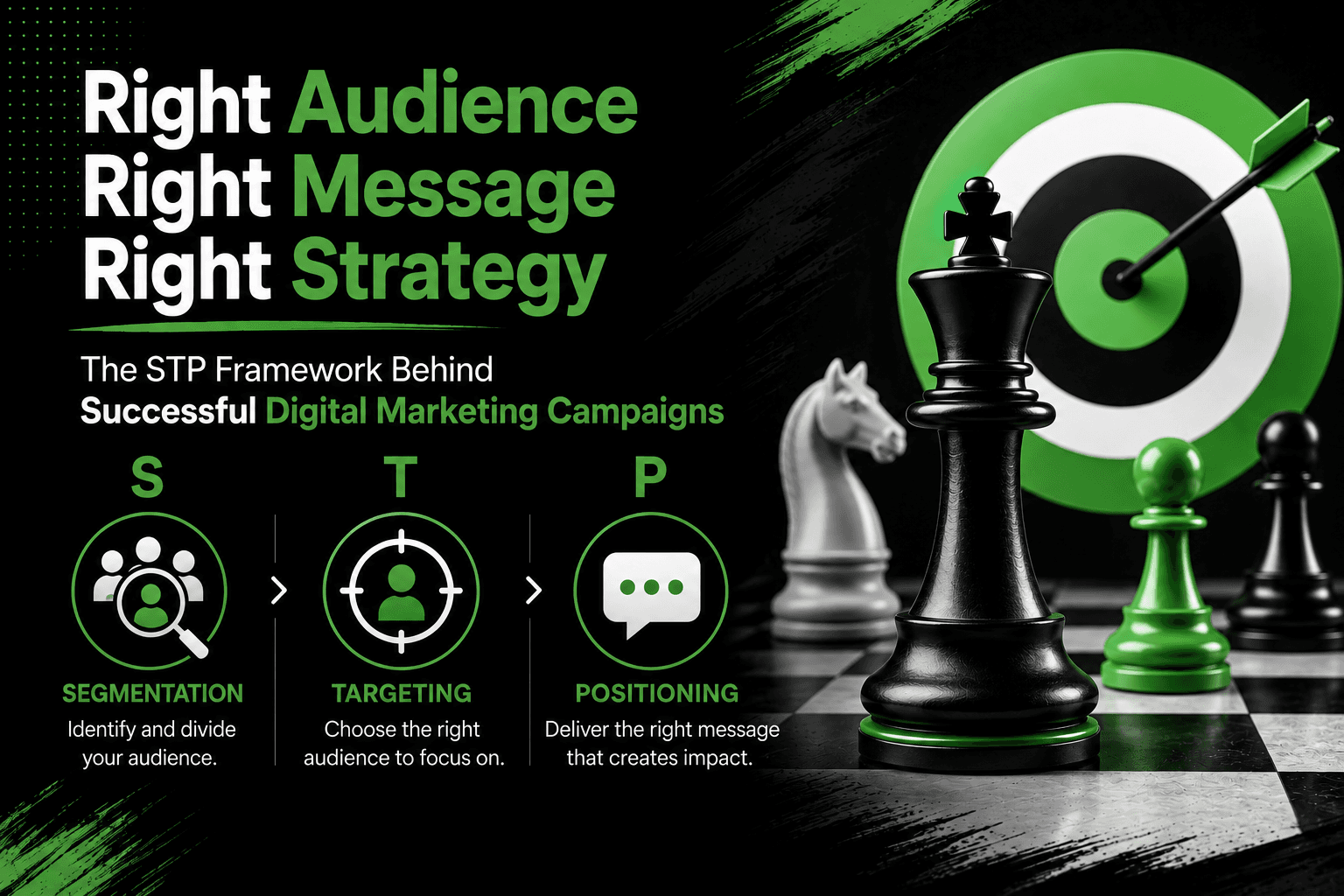
Right Audience. Right Message. Right Strategy: The STP Framework Behind Successful Digital Marketing Campaigns
Trying to talk to everyone means connecting with no one. Learn the STP Framework — Segmentation, Targeting, and Positioning — and how it turns real campaigns that actually convert.
August 28, 2026 · Aysha Rizwana
Read digital marketing
Experience Excellence: Explore the Amenities at Techoriz Digital Academy, HiLITE Business Park, Calicut
Experience Excellence: Explore the Amenities at Techoriz Digital Academy, HiLITE Business Park, […]
March 12, 2025 · Techoriz Digital Academy
Read digital marketing
Success Stories of Techoriz Digital Academy Students
Success Stories of Techoriz Digital Academy Students At Techoriz Digital Academy, we […]
March 12, 2025 · Techoriz Digital Academy
Read