general
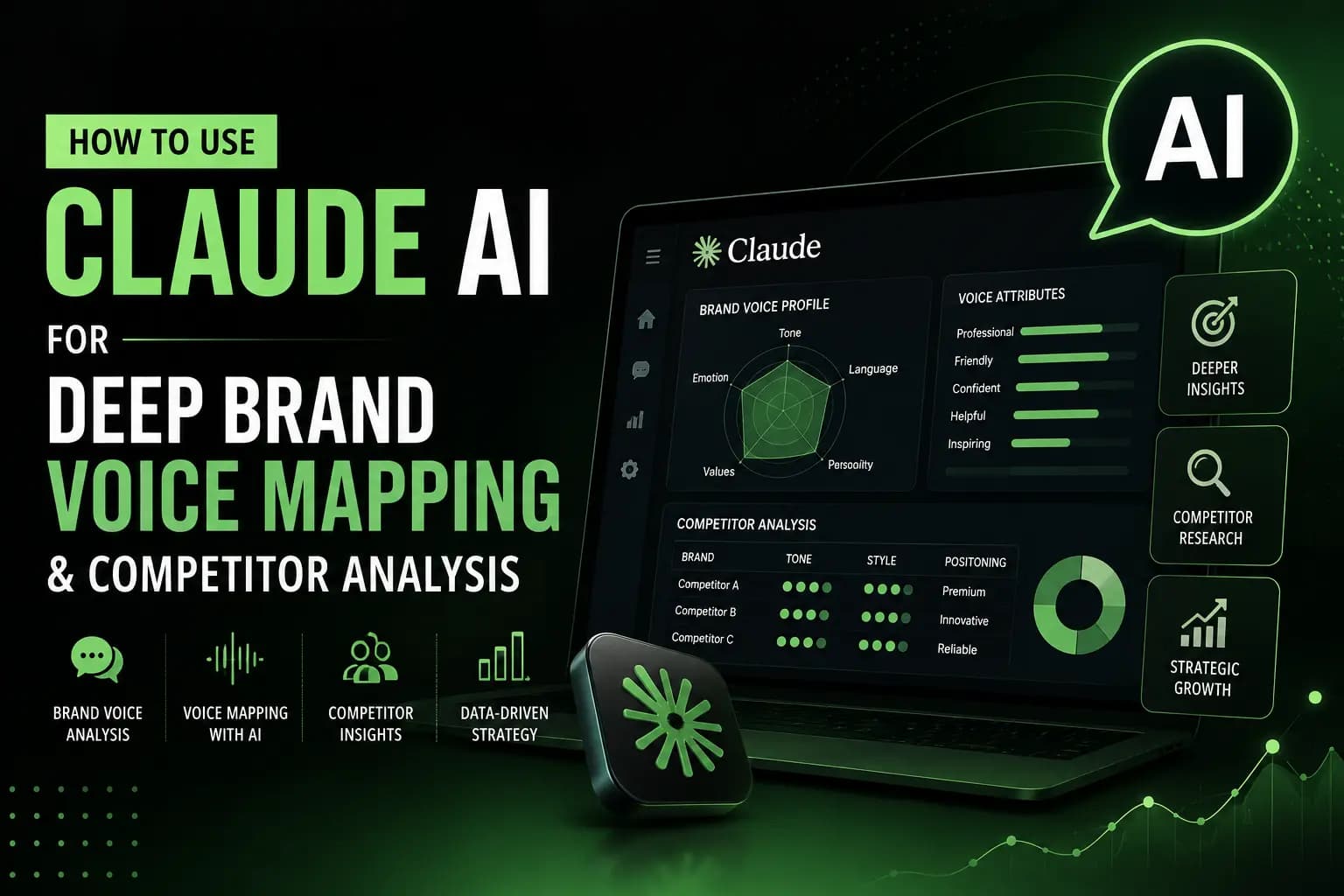
How to Use Claude AI for Deep Brand Voice Mapping and Competitor Analysis
July 13, 2026 · By Megha
How to Use Claude AI for Deep Brand Voice Mapping and Competitor Analysis
If you run a business, write content, or manage marketing, you already know two things are hard:
- Figuring out exactly how your brand should “sound” everywhere
- Understanding what your competitors are doing better (or worse) than you
Most people try to do this with gut feeling. A little bit here, a little bit there. No real system.
This is where Claude AI can help. Not as a magic button, but as a thinking partner that helps you go deep — into your own brand voice, and into your competitors’ strategies.
Let’s break this down in plain language.
What Is "Brand Voice Mapping"?
Brand voice is simply: how your brand talks.
Is it funny or serious? Simple or technical? Warm or bold? Do you use short sentences or long ones? Do you sound like a friend, a teacher, or an expert?
“Mapping” your brand voice means writing all of this down clearly, so anyone on your team — or any AI tool — can follow it consistently.
Most businesses never write this down. It just lives in someone’s head. That’s a problem, because it means every blog post, ad, email, and social caption sounds a little different.
Claude can help you fix this by turning your scattered ideas into a clear, structured voice guide.
Step 1: Feed Claude Your Existing Content
Start by giving Claude real examples of your brand’s writing. This could be:
- Your website homepage
- A few blog posts
- Social media captions
- Email newsletters
- Customer reviews people have written about you
Paste 3–5 examples into Claude and ask something like:
“Here are a few pieces of content from my brand. Based on these, describe my brand’s tone, personality, sentence style, and the words I tend to use or avoid.”
Claude will read the patterns and describe your voice back to you — often catching things you didn’t even realize you were doing.
Step 2: Build a Brand Voice Guide
Once Claude gives you its first read, ask it to turn that into a proper guide. Something like:
“Turn this into a simple brand voice guide with these sections: Tone, Personality traits, Words we use, Words we avoid, Sentence style, and 3 example sentences in our voice.”
Now you have something real. A document your whole team — or any freelancer, designer, or AI writing tool — can follow. No more guessing.
This is the “deep mapping” part. You’re not just saying “we sound friendly.” You’re defining exactly what friendly means for your brand, with examples.
Step 3: Test the Voice on New Content
A good voice guide should work like a filter. Try this:
“Using the brand voice guide above, write an Instagram caption announcing our new product.”
Then ask Claude to check its own work:
“Does this match our brand voice guide? What would you change?”
This back-and-forth is where the real value shows up. You’re not just writing content — you’re training a consistent voice you can reuse forever.
Now Let's Talk Competitor Analysis
Once your own voice is clear, the next step is understanding the competition. Not to copy them — to see the gaps you can fill.
Claude can’t browse competitor websites on its own unless you give it the text. So the easiest method is simple:
- Copy content from a competitor’s website, blog, or social posts
- Paste it into Claude
- Ask Claude to analyze it
Step 4: Compare Voice and Positioning
Try a prompt like:
“Here is content from my competitor. Compare their tone, personality, and messaging style to my brand voice guide. What’s similar? What’s different? Where is there an opportunity for my brand to stand out?”
Claude will lay out the differences clearly — for example, maybe your competitor sounds very corporate and formal, while your brand has room to feel more human and approachable.
This is incredibly useful because it’s not just “look at what they’re doing” — it’s “here’s where you can be different.”
Step 5: Spot Messaging Gaps
Ask Claude to go one level deeper:
“Based on this competitor’s content, what topics, questions, or customer concerns are they NOT addressing? What could I write about that they’re missing?”
This helps you find content ideas and messaging angles your competitors haven’t touched yet — a much smarter way to compete than just copying their homepage headline.
Step 6: Build a Simple Comparison Table
For a clean overview, ask Claude:
“Create a simple comparison table: my brand vs. this competitor, across tone, target audience, key message, and content style.”
This gives you (and your team) a one-page snapshot that’s easy to reference during meetings or planning sessions.
A Simple Workflow You Can Reuse
Here’s the whole process in order:
- Paste your own content into Claude → get your voice described
- Turn that into a written brand voice guide
- Test the guide on new content and refine it
- Paste competitor content into Claude
- Compare voice, tone, and positioning
- Find messaging gaps you can fill
- Build a simple comparison table for quick reference
Do this once, and you’ll have a reusable system — not a one-time exercise.
Why This Actually Matters
Brands that sound consistent build more trust. People remember them. Teams write faster because they’re not guessing. And when you understand exactly where competitors are weak, you know exactly where to lean in.
Claude won’t replace your judgment. But it’s an excellent second brain — one that reads carefully, remembers patterns, and helps you turn “I think we sound like this” into a clear, usable, repeatable brand system.
Start small. Paste a few pieces of your own content in today, and see what Claude notices about your voice that you didn’t.

Author
Megha
Digital Marketing Executive cum Trainer
* Join Techoriz
Ready to master digital marketing?
Learn with Kerala's first ISO-certified agency-based digital marketing academy. Get expert training, live projects, and 95% placement support.
Keep reading
Related Posts
 general
Why Choose a NSDC-Recognised Digital Marketing Course in Kerala?
Why Choose a NSDC-Recognised Digital Marketing Course in Kerala? If you’ve spent […]
August 1, 2026 · Ajmal Rishan
Read general
ChatGPT vs Google Search: What Marketers Need to Know
For more than two decades, search engines have shaped the way people […]
July 31, 2026 · Shahala Sherin
Read general
Match Types in 2026: How “Broad Match + Smart Bidding” Has Changed Keyword Strategy
Match Types in 2026: How “Broad Match + Smart Bidding” Has Changed […]
July 29, 2026 · Megha
Read