At Techoriz Digital Academy, Calicut, our curriculum covers AI-integrated search strategies — including AEO — as part of our advanced digital marketing programmes.

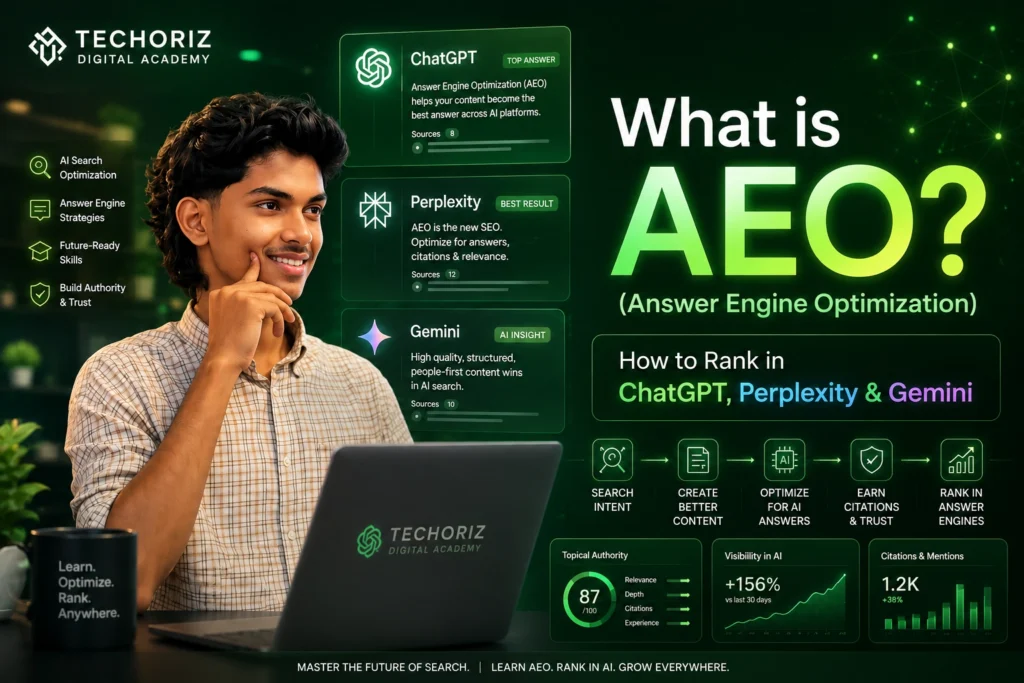
Think about the last time someone asked you, “Which is the best digital marketing course in Calicut?” — did they Google it, or did they just ask ChatGPT? If you thought “probably ChatGPT,” you already understand why AEO matters.
Search behaviour has fundamentally shifted. People used to type keywords into Google, scroll through ten blue links, and click. Today, millions of people are skipping that process entirely and just asking an AI — “What’s the best way to learn digital marketing?”, “Which institutes in Kerala offer placement?”, “Is freelancing better than a job for freshers?” The AI gives them one synthesised answer, names a few sources, and the user moves on. No scrolling. No clicking.
If your brand isn’t inside that AI-generated answer, you effectively don’t exist for that query.
That’s where Answer Engine Optimisation (AEO) comes in. And if you’re a marketer in 2026 who hasn’t heard of it yet — this is the most important thing you’ll read this month.
Answer Engine Optimisation is the practice of structuring and presenting your digital content so that AI-powered platforms — ChatGPT, Perplexity, Google Gemini, Claude, Microsoft Copilot — can extract, understand, and cite it when generating responses to user queries.
Traditional SEO gets you onto the first page of Google results. AEO gets you inside the answer itself — before the user even sees a list of links.
Answer Engine Optimisation (AEO) the process of optimising your content so AI search platforms select and cite it when answering user questions — rather than users finding you through traditional search results.
The platforms we’re talking about aren’t fringe tools. ChatGPT crossed 200 million weekly users in 2024. Perplexity is used by over 15 million people a day. Google AI Overviews now appear on roughly 15% of all search queries, often pushing organic results below the fold. People are genuinely using these tools as their primary research instruments — especially for career decisions, product comparisons, and educational choices.
This is the question every marketer and student asks first, and it’s a fair one. They’re related, but they optimise for fundamentally different outcomes.
| Aspect | Traditional SEO | AEO (Answer Engine Optimisation) |
|---|---|---|
| Goal | Rank on Google’s first page | Get cited inside an AI-generated answer |
| Format | List of links (SERP) | One synthesised response |
| User action | Clicks through to your page | Often zero-click-AI answers directly |
| What matters most | Backlinks, domain authority, keywords | Content structure, clarity, topical depth, schema |
| Measurement | Traffic,rankings,CTR | Citation frequency, brand mentions in AI responses |
| Content structure | Optimised for crawlers | Optimised for AI extraction |
Here’s the crucial part though — AEO doesn’t replace SEO. Both matter. Roughly 38% of AI Overview citations still come from pages that rank in Google’s top 10. Strong SEO authority feeds AEO. But SEO alone is no longer sufficient if you want visibility in AI-powered responses.
“Search used to mean clicking links. By 2026, most users
skip the links entirely. If your brand is not inside that AI
answer, you do not exist for that query.”
Students and business owners in Kozhikode, Kochi, Kannur, and Trivandrum are increasingly using ChatGPT and Gemini to research courses, compare institutes, and find services. Queries like “best digital marketing course in Calicut,” “digital marketing salary in Kerala,” and “freelancing vs job for freshers in India” are being asked in AI chat interfaces — not just Google.
Most Kerala businesses and institutes haven’t started optimising for AI answers yet. The first movers here will own that space for years. This is the same advantage early SEO adopters had in 2010.
The opportunity gap is real. National blogs and large institutes are waking up to AEO, but hyper-local, intent-specific content from regional institutes — answering questions that a student in Calicut is actually asking — is almost entirely absent from AI answers right now. That’s a gap worth filling urgently.
This is where it gets practical. AI platforms like Perplexity and ChatGPT don’t crawl the web the way Google does. They process, understand, and store content differently. Here’s what they’re looking for:
AI engines extract the first one or two sentences of each section to decide if your content answers a query. If your opening line is vague or is a long preamble (“In today’s rapidly evolving digital landscape…”), the AI moves on to someone else’s content. Lead every section with the direct answer first, then explain.
Descriptive headings, short paragraphs, bullet points, and numbered lists all help AI systems parse what your page is about. Think of it as writing for someone who’s skimming extremely fast — because that’s essentially what an AI does when indexing your content for potential citation.
AI platforms favour sources that cover a topic comprehensively. A site with 20 detailed posts on digital marketing for Kerala students will be cited more frequently than a site with one generic post trying to cover everything. Build clusters of content around one area, not scattered individual posts.
Google’s E-E-A-T framework (Experience, Expertise, Authoritativeness, Trustworthiness) has become even more relevant for AEO. AI systems want to cite credible sources. This means having an About page, real author names and bios, verifiable credentials, and links to your social profiles. It signals to the AI: this is a real entity that knows what it’s talking about.
Use actual questions as headings (“What is AEO?”, “How does GEO differ from SEO?”) and answer them directly in the first sentence below. This mirrors exactly how users query AI platforms — in full, conversational questions. AI systems are far more likely to cite content that structurally matches the question being asked.
FAQPage schema is the single highest-impact AEO tactic available right now. It tells AI platforms exactly where your Q&A content is, making it trivial to extract and cite. Add at least 4–6 relevant FAQs to every blog post and mark them up with JSON-LD schema in the <head> of the page. WordPress users can do this with plugins like Rank Math or Yoast.
Don’t write one standalone post and hope for the best. AI engines favour sites that cover a topic from every angle. Pick 3–4 core themes (for example: AI in digital marketing, career paths in digital marketing, freelancing for students) and build 8–10 posts around each theme. Link them internally. Together, they establish your site as the definitive source on that subject.
AI systems are trained to prefer content from identifiable human experts over anonymous pages. Every blog post should have a named author with a bio, a photo, and links to their LinkedIn or other professional profiles. Use Person schema to mark this up technically. It closes the trust loop that AI engines need before they’ll cite you.
When AI summarises a topic, it needs specific, citable facts. Content packed with statistics (“AI-referred traffic grew 527% between January and May 2025”), named studies, and verifiable data gets cited far more often than general opinion pieces. Whenever possible, reference credible sources — research reports, Google announcements, industry studies — and link to them.
Organization schema tells AI systems who you are as a business — your name, location, what you do, and your social profiles. Without this, AI platforms have no verified entity to attribute content to. For a digital academy in Kozhikode, this is especially important for appearing in local and regional AI queries.
AI engines don’t just look at your website. They look at what the web says about you. Getting mentioned on third-party sites — industry roundups, news articles, review platforms, YouTube, local business directories — builds the off-site authority signals that AI platforms use to verify credibility. Encourage student testimonials, get listed in “best institutes” posts, and pursue earned media wherever you can.
Each AI search engine has slightly different tendencies. Here’s what to know:
Prioritises content from well-known domains and pages with strong backlink profiles. Clear authorship and E-E-A-T signals are critical. Being featured in third-party articles and directories increases citation chance significantly.
Actively crawls and cites real-time web pages — more so than ChatGPT. Well-structured, up-to-date articles with direct answers perform best. It frequently cites niche blogs if the content is fresh and specific.
Pulls heavily from sites that already rank well organically. FAQPage schema and HowTo schema have measurable impact here. Keeping content updated with recent dates also matters — freshness is a signal.
Here’s the honest answer: AEO is one of the fastest-growing skill gaps in the industry right now. Most working digital marketers in India learned SEO in a world where Google was the only game in town. The transition to AI-first search has caught a lot of experienced professionals off-guard.
Students learning digital marketing in 2026 have a genuine advantage — they’re entering the field at a moment when AEO skills are valuable, rare, and actively sought after by agencies and brands trying to figure this out.
If you can walk into an interview and explain the difference between SEO, AEO, and GEO — and then show a client how to implement FAQ schema on their WordPress site — you are immediately more valuable than 80% of candidates with the same years of experience.
If you want to start implementing AEO on your content today, here’s where to begin:
There’s a temptation to treat AEO as a “future trend” — something to prepare for later. That instinct is wrong. The shift is already happening. AI-referred web traffic grew by over 500% in 2025 alone. The businesses and creators who start optimising for AI answers now will accumulate authority, citations, and visibility that becomes very hard to displace later.
The good news? The fundamentals aren’t complicated. Write clearly. Answer questions directly. Structure your content well. Add schema markup. Build credibility on and off your site. These aren’t exotic technical skills — they’re good content habits, upgraded for 2026.
SEO taught a generation of marketers to think about Google first. AEO asks you to think about the reader first — and trust that the AI will follow. It turns out that’s not such a bad way to write anyway.
At Techoriz Digital Academy, Calicut, our curriculum covers AI-integrated search strategies — including AEO — as part of our advanced digital marketing programmes.

WhatsApp us