
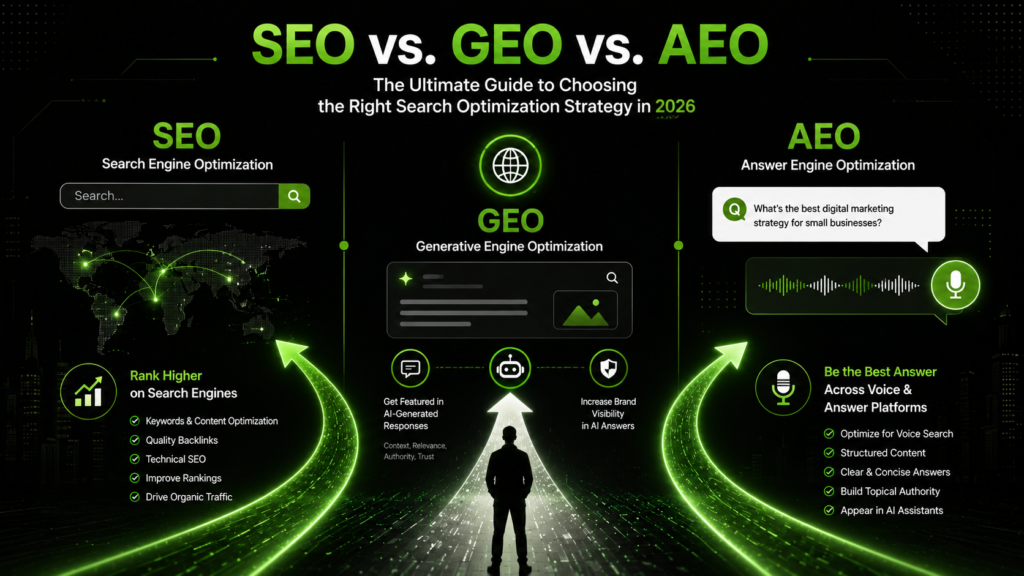
The way we search for information has changed completely.
It’s not gone — it’s just replaced by something that’s faster, smarter, and less predictable.In 2026, about 70% of searches on Google end without anyone clicking on a website.ChatGPT handles 2.5 billion queries each day, and 65% of these are searches.Google’s AI Overviews now show up at the top of search results for millions of queries, and these overviews have reduced the number of clicks on the top-ranking pages by up to 58%.
If you’re a digital marketer, business owner, or student training for a career in this field, three acronyms now define your online visibility: SEO, AEO, and GEO.
Each one targets a different kind of search experience. Each one requires a different strategy. Understanding SEO vs GEO vs AEO helps you choose the right optimization approach, and if you only focus on one while ignoring the others, you’re missing out on a lot of traffic — and revenue.
This guide explains what each strategy means, how they differ, and — most importantly — which one you should focus on based on your goals in 2026.
Search Engine Optimization (SEO) is the process of changing your website’s structure and content so it can rank better in traditional search engines like Google and Bing.
When you type a query into Google and see a list of ten blue links, SEO is what got those pages there.
SEO focuses on:
What SEO measures: Rankings, organic traffic, click-through rates (CTR), and conversions from search.
For more than twenty years, SEO has been the main strategy used by digital marketers.Even with the changes brought about by AI and new technologies, SEO is still a powerful tool today.
Although traditional organic search continues to drive most web traffic worldwide, Google processes over 8.5 billion searches every day, and companies that rank #1 on the first page of search engine results pages (SERPs) still get most of that traffic.
However, what counts as a “page one” result is changing.Before AI, a top ranking often got 30% or more of all clicks.Today, with AI Overviews appearing above organic results, a first-place ranking might only get half of the clicks it once had.
SEO is not dying. But on its own, it’s no longer enough.
AEO is the practice of optimizing your content to appear directly inside answer boxes, featured snippets, voice search responses, and AI-powered answer features within search engines.
When you ask Google “What is the best time to post on Instagram?” and the top result gives you the answer without needing to click through multiple links — that’s an example of Answer Engine Optimization (AEO) at work.
AEO focuses on:
AEO is a measurement method that looks at whether a feature snippet appeared or not when using voice search, whether that snippet received traffic or not based on the voice query, whether it was shown in a zero-click query, and where the direct answer was positioned on Google’s Search Engine Result Page (SERP) in relation to the specific keyword.
AEO became a new area of study when Google started pulling direct answers from web pages instead of just ranking them.The goal shifted from “rank for this keyword” to “be the answer to this question.”
In 2026, AEO is more important than ever because AI-powered search systems are built on the same principle: find the best, most direct answer to a user’s question and show it right away.The better you optimize your content for AEO, the more prepared you’ll be for the future of AI.
GEO is the newest — and most talked about — optimization strategy in 2026.It is the practice of optimizing your content so that generative AI systems like ChatGPT, Google Gemini, Perplexity, Microsoft Copilot, and Claude cite your content when generating their responses.
The key difference is that traditional SEO gets you a ranking.With GEO, your content gets credit in an AI-generated answer, and the user never has to leave the AI response to go to your website.
GEO focuses on:
What GEO measures:
AI citations, brand mentions in AI responses, AI-referred traffic, and conversions from AI-sourced visits.
GEO was introduced as a formal concept by Princeton researchers in 2023.If brands want to stay visible in more and more search queries and not rely solely on classic search engine results pages (SERPs), they will need to invest significantly in creating quality content for these areas (e.g., Google Maps or similar).
Princeton research confirms that the right optimization techniques — adding citations, statistics, and authoritative quotes — can improve your visibility in AI-generated responses by 30 to 40% compared to unoptimized content
| SEO | AEO | GEO | |
|---|---|---|---|
| Goal | Rank on Google's results page | Appear in answer boxes and featured snippets | Get cited in AI-generated responses |
| Target Platforms | Google, Bing | Google, Bing, Voice Assistants | ChatGPT, Gemini, Copilot, Claude |
| Primary Output | Rankings and Organic Clicks | Zero-click Answer Placement | AI Citations and Brand Mentions |
| Key Tactics | Keywords, Backlinks, Technical SEO | FAQ Schema, Structured Q&A Content | Citations, Statistics, Entity Authority |
| Traffic Type | Click-based Organic Traffic | Impression-based + Some Clicks | AI-referred Traffic (High Intent) |
| Maturity | 25+ Years of Best Practices | 8–10 Years | 2–3 Years (Early Adopter Opportunity) |
| Difficulty | High Competition | Moderate Competition | Low Competition (For Now) |
The SEO vs GEO vs AEO comparison makes one thing clear: these strategies are not competitors. Instead, they complement one another to help businesses improve visibility across search engines, AI-powered search experiences, and answer platforms.
One of the biggest misconceptions about SEO vs GEO vs AEO is that marketers think they are competing strategies — as if choosing one means abandoning the others.
They are not competing. They are layered.
As one industry framework puts it: SEO establishes baseline visibility, AEO ensures accessibility in answer-driven features, and GEO positions content to be synthesized and cited by AI engines.
Not all AI systems think alike. If you are investing in GEO, you need to understand what each platform values:
Understanding SEO vs GEO vs AEO helps you decide where to invest your time and marketing budget based on your business stage.
If you are a beginner or a new business:
Start with SEO. There is no shortcut here. Build your technical foundation, create quality content, and earn your first organic rankings. Without this base, AEO and GEO efforts will have nothing to amplify. Focus your first 6–12 months entirely on solid on-page and technical SEO.
If you are an intermediate marketer with existing rankings:
Add AEO to your strategy. Audit your best-performing content and restructure it for direct answers. Add FAQ schema to your pages. Create dedicated Q&A sections around your target queries. This will both protect your existing traffic from zero-click erosion and prepare your content for AI citation.
If you are an advanced marketer or an established brand:
GEO is your competitive edge right now — and the window is narrowing. Build original research and data assets that AI systems will want to cite. Establish entity authority by maintaining consistent NAP (Name, Address, Phone) data, earning press mentions, building reviews, and maintaining an active cross-platform presence. Track your AI citation rate as a core KPI alongside your organic rankings.
If you are a freelancer or agency:
GEO knowledge is a genuine differentiator in 2026. Very few practitioners understand how to execute it well. Positioning yourself as someone who can audit and improve a brand’s AI visibility — not just its Google rankings — opens an entirely new service category.
| Step 1 |
Audit your SEO foundation Use Google Search Console and a crawl tool (Screaming Frog, Ahrefs, or Semrush) to identify technical issues, thin content, and missing metadata. Fix these before touching anything else. |
| Step 2 |
Map your content to questions For every major topic you cover, identify the specific questions your audience is asking. Reformat your content to answer those questions clearly and concisely. Add FAQ schema. This is your AEO layer. |
| Step 3 |
Add citable elements to your content Go through your best content and add: original statistics with sources, expert quotes (even brief ones), data visualizations, and original research or case studies. These are the building blocks of GEO visibility. |
| Step 4 |
Build your entity authority Claim and complete your Google Business Profile. Publish on LinkedIn consistently. Get mentioned in industry publications. Collect genuine reviews on third-party platforms. Make it easy for AI systems to confirm your brand is real, reputable, and relevant. |
| Step 5 |
Measure AI visibility alongside traditional KPIs Start tracking how often your brand appears in AI-generated responses. Tools like Semrush's AI Toolkit, Brandwatch, and Surmado's AI Visibility tracker allow you to monitor citations across major AI platforms. Set a baseline today — because this metric will matter as much as your organic ranking by 2027. |
The question in 2026 is no longer SEO vs GEO vs AEO. The real question is how to combine all three into one powerful search visibility strategy.SEO keeps you visible in traditional results — which still drive the majority of web traffic. AEO positions you inside the answer features that are eating into those clicks. GEO ensures you are cited when someone asks an AI system a question your business is uniquely qualified to answer.The brands, marketers, and freelancers who will dominate search visibility in the next three years are the ones who stop thinking about these as separate disciplines and start treating them as a single, integrated visibility system.
The good news: most of your competitors are still only doing SEO. The window to get ahead on AEO and GEO is open right now — but it will not stay open for long.
No. SEO is evolving, not dying. Traditional organic search still drives the majority of global web traffic, and Google processes over 8.5 billion searches every day. What has changed is that ranking number one no longer guarantees the same volume of clicks it once did — AI Overviews and zero-click features now intercept many queries before users reach your page. The answer is not to abandon SEO but to pair it with AEO and GEO so your brand stays visible across all types of search experiences.
Think of it this way: SEO gets you onto Google’s results page. AEO gets you inside the answer box at the top of that page. GEO gets you mentioned inside the response that ChatGPT, Gemini, or Perplexity generates — even before the user opens a browser. Three different destinations, three different strategies, one unified goal: visibility.
There isn’t a single winner in the SEO vs GEO vs AEO debate. SEO builds your search foundation, AEO helps your content appear as direct answers, and GEO improves your visibility across AI-powered search platforms. The most successful brands combine all three.
Several tools now track this. Semrush’s AI Toolkit, Surmado’s AI Visibility tracker, and Brandwatch all allow you to monitor how often your brand is mentioned or cited in AI-generated responses across major platforms. You can also do manual checks by typing your target queries directly into ChatGPT, Perplexity, and Gemini and noting whether your brand or content appears in the response. Set a baseline measurement today, because AI citation rate is becoming a standard KPI alongside organic rankings.
GEO is structural, not a trend. The shift toward AI-powered search has been building for years and is now embedded in how the world’s largest platforms — Google, Microsoft, OpenAI — deliver information to users. The specific tactics within GEO will evolve as AI systems improve, just as SEO tactics have evolved over two decades. But optimizing for AI visibility is not optional for brands that want to remain discoverable as search behavior continues to shift.

WhatsApp us