
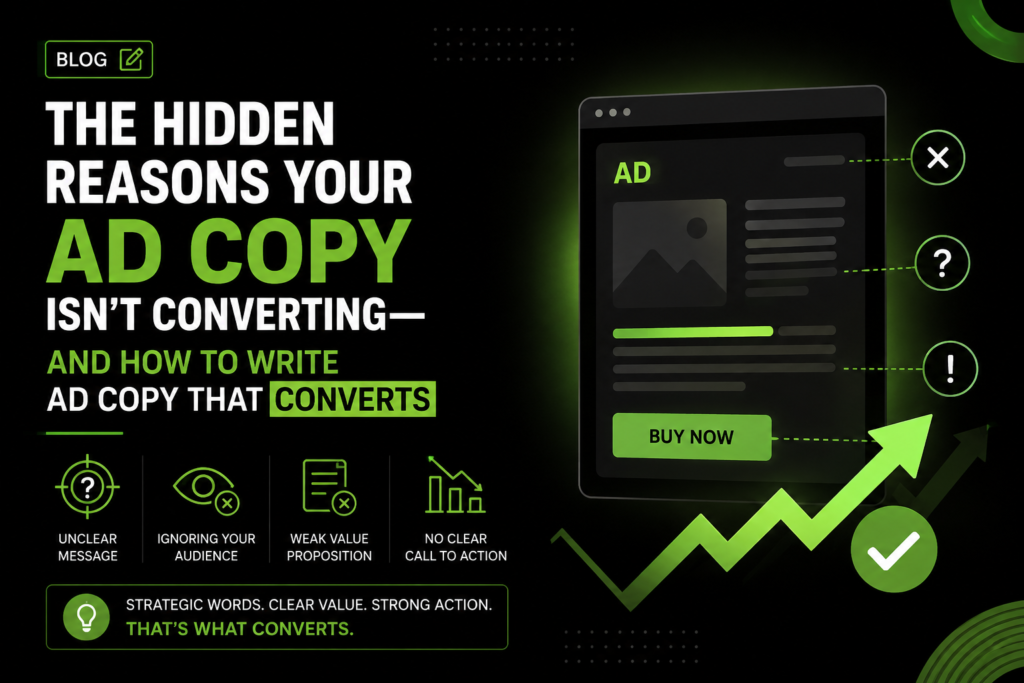
Keyword (How to Write Effective Ad Copy )
You wrote the ad. You picked a good product, targeted the right audience, even boosted the budget a little. And still—clicks trickle in, but sales don’t follow.
Most marketers blame the product, the audience, or the platform. Rarely do they blame the words. But in most cases, that’s exactly where the problem lives.
Here’s what’s actually going wrong—and how to fix it.
Ad copy conversion rate is the percentage of people who take action after reading an ad — a click, a sign-up, a sale. When that number stays low despite a good product, the right audience, and a healthy budget, the cause is almost always the copy itself, not the offer behind it.
Here’s what’s actually going wrong with underperforming ad copy, and the fixes that turn it into copy that converts.
Ad copy usually fails to convert because of weak headlines, feature-heavy messaging instead of benefit-driven messaging, vague calls-to-action, and a lack of emotional pull — not because of the product or the platform.
Industry data backs this up: a strong headline alone can drive roughly 3x higher conversion rates, and the average landing page conversion rate sits between 6-10% across industries, with top performers reaching 15% or more.
Fixing five elements — headline strength, audience specificity, emotional trigger, CTA clarity, and tone — typically improves conversions without increasing ad spend.
| Problem | Weak Copy | Converting Copy |
|---|---|---|
| Feature-dumping | "10-hour battery life" | "Never carry a charger again" |
| Generic headline | "Check Out Our New Range" | "Why Your Moisturizer Stopped Working" |
| Talking to everyone | "Amazing quality, affordable prices" | "Stop losing your to-do list in 10 apps" |
| No emotional pull | Lists facts and specs | Triggers relief, pride, or urgency |
| Vague CTA | "Learn More" | "See Your Free Growth Plan" |
| Leads with brand info | "Award-winning company since 2015..." | Opens with the reader's problem |
| Generic AI tone | "Unlock your potential today" | Specific, human, brand-voiced copy |
“Lightweight, waterproof, 10-hour battery life” tells people what a product has. It says nothing about what changes in their life once they own it. People buy outcomes, not specs — confidence, relief, time saved, status.
Fix it: For every feature you write, ask “so what?” until you land on a feeling. “10-hour battery” becomes “never dies mid-meeting” becomes “you stop carrying a charger everywhere.” That last line is your ad copy, not the spec sheet.
Before someone reads a single line of body copy, the headline decides whether they stay or scroll. A headline with no curiosity, urgency, or relevance gets skipped, no matter how good the offer is underneath it. Data from landing page studies shows a strong, benefit-driven headline can produce roughly three times the conversion rate of a weak one.
Weak: “Check Out Our New Skincare Range”
Strong: “Why Your Moisturizer Stopped Working (It’s Not Your Skin)”
Fix it: Write ten headline variations before picking one. The first version you write is almost never the strongest.
Copy like “Amazing quality, affordable prices” could describe any product in any category. It doesn’t stop a scroll because it isn’t written for a specific person’s specific frustration.
Fix it : “Boost your productivity” is vague — it could describe any product. “Stop losing your to-do list in fifteen different apps” names one specific, real problem, so it feels like it’s speaking to that person directly.
Logical copy informs. Emotional copy drives action. Most underperforming ads are factually correct and completely flat — no fear of missing out, no relief, no pride, nothing that makes someone feel something.
Fix it: After writing a line, ask what emotion it creates. If the honest answer is “none,” rewrite it until there’s one.
“Learn More” and “Click Here” ask for nothing specific and promise nothing back. They’re the copywriting equivalent of a shrug, and they consistently underperform CTAs that name the exact next step. Personalized, specific CTAs convert significantly more visitors than generic ones, based on landing page benchmark studies.
How to fix a weak CTA in 3 steps:
Example: “Learn More” becomes “See Your Free Growth Plan.”
“Sign Up” becomes “Start Your 7-Day Trial (No Card Needed).”
Many ads open with company background, awards, or a mission statement. Nobody scrolling their feed cares yet — interest has to be earned before information is offered.
Fix it: Open with the reader’s problem or desire first. Save credibility markers like awards and years in business for after attention is already won.
AI tools are excellent for speed but default to generic phrasing — “unlock your potential,” “elevate your experience,” “in today’s fast-paced world.” When every brand sounds identical, none of them stand out.
Fix it: Use AI for a fast first draft, then rewrite with specific details, real numbers, and phrasing only your brand would use. AI-assisted is the goal, not AI-identical.
Before: “Introducing our new fitness app. Track workouts, set goals, and stay motivated. Download today!”
After: “You’ve started your fitness journey five times this year. Here’s the app that finally makes it stick — 3-minute check-ins, real accountability, zero guilt. Start Day 1 Free.”
Same product, same offer. Completely different conversion potential — because the second version speaks to a real frustration instead of listing features.
There’s no fixed rule. Short copy suits impulse, low-cost purchases. Longer copy tends to perform better for higher-priced or more considered products, since it has room to build trust and handle objections.
AI is strong for fast first drafts, but raw AI output tends to sound generic. The best results come from using AI to draft quickly, then editing in specific details and a distinct brand voice.
Leading with the brand instead of the reader’s problem. Beginners tend to write the way a company describes itself, not the way a customer describes their own frustration — and that gap kills conversions.
Track click-through rate on the CTA itself, not just overall ad engagement. Specific CTAs like “See Your Free Growth Plan” consistently outperform vague ones like “Learn More.”
Emotional triggers usually drive the decision, while logical details like specs and guarantees justify it afterward. Strong ad copy typically uses both — emotion to persuade, logic to reassure.
Clicks confirm your headline and targeting are working. A lack of sales usually points to weak copy, an unclear value proposition, or a vague CTA once someone lands on the page.
How to Write Effective Ad Copy that converts isn’t about clever wordplay—it’s about understanding exactly who you’re talking to, what they’re feeling, and what they need to hear next. When you truly understand your audience, How to Write Effective Ad Copy becomes much easier because every word has a purpose.
At Techoriz Digital Academy, you’ll learn How to Write Effective Ad Copy through hands-on practice, alongside SEO, paid advertising, and AI-integrated digital marketing tools. Instead of relying only on theory, you’ll work on real campaigns that show you How to Write Effective Ad Copy for different industries and business goals.
Whether you’re a student, freelancer, business owner, or aspiring marketer, mastering How to Write Effective Ad Copy can help you generate more clicks, more leads, and more sales. Our practical training is designed to build the skills that today’s top brands use every day.
Ready to master How to Write Effective Ad Copy and create ads that actually convert? Explore our AI-Integrated Digital Marketing courses at Techoriz Digital Academy and discover How to Write Effective Ad Copy through real-world projects, expert guidance, and industry-focused training.
.

WhatsApp us