
If you’re searching for a practical digital marketing course in Calicut, you’ve probably already sat through — or read reviews of — a class where the instructor talks about Google Ads for two hours and you never once open the Ads dashboard.
You can memorize what a “Quality Score” is. You can define “bounce rate” on an exam. But the first time you’re handed a client’s actual ad account with real money on the line, none of that matters if you’ve never clicked the buttons yourself.
That’s exactly the gap a genuinely practical digital marketing course closes. And it’s the single biggest difference between a course that gets you a job in Calicut’s growing digital economy and one that only gets you a certificate.
Digital marketing looks deceptively simple on a slide. SEO is “optimize your content for search engines.” Social media marketing is “post consistently and engage your audience.” Google Ads is “bid on keywords to show your ad.”
None of that is wrong. It’s also nowhere near enough.
Real digital marketing work looks like this: a client’s website traffic drops 40% overnight and you have to figure out why — algorithm update, technical issue, or a competitor outranking them. An ad campaign is burning budget with zero conversions and you need to diagnose it in the next hour, not the next semester. A social post underperforms and you have to adjust strategy on the fly, not wait for the “next module.”
Students who’ve only studied theory freeze in these moments. Students who’ve actually done the work don’t.
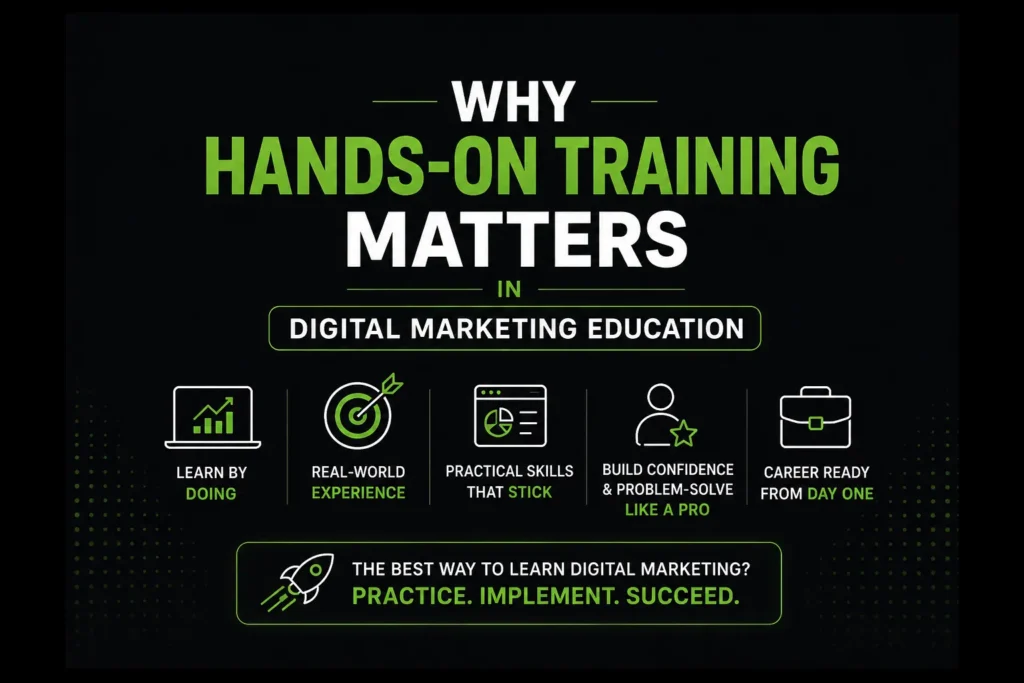
At Techoriz Digital Academy in Calicut and Kannur, the training model is built around one core idea: you learn digital marketing by doing digital marketing, not by reading about it.
You work on live client accounts, not fictional case studies. There’s a real difference between optimizing a “sample e-commerce store” in a textbook exercise and optimizing an actual Kerala business’s Google Ads account where a wrong move costs real money. The stakes teach you things a mock scenario never can — attention to detail, accountability, and how to explain your reasoning when a client asks “why did you do that?”
You make mistakes where it’s safe to make them. A classroom is the right place to accidentally set a campaign budget wrong or misconfigure a tracking pixel — because a trainer is there to catch it and explain the fix. Making that same mistake on your first solo job, with no safety net, is a much harder way to learn.
You build a portfolio instead of a transcript. When you’ve actually run campaigns, written live content, and optimized real websites, you walk into an interview with proof — screenshots, results, case studies — rather than just a list of topics you covered.
You develop instincts, not just knowledge. Ask an experienced marketer why they chose a particular keyword strategy or ad format, and they’ll often say “it just felt right based on the data.” That instinct only comes from repetition — running dozens of campaigns, seeing what works, seeing what fails, and understanding why.
Calicut and Kannur have a fast-growing base of small and medium businesses — from local retail and hospitality to education and healthcare — that are only just beginning to invest seriously in digital marketing. Agencies and in-house marketing roles in this market don’t have the bandwidth to train someone from zero on the job. They need people who can contribute from day one.
That’s exactly the gap agency-based, live-client training is designed to fill. Employers in Kerala aren’t just asking “do you know what SEO is?” They’re asking “can you audit our website and tell us what’s wrong with it this week?” Only practical experience prepares you to answer that with confidence.
Good hands-on digital marketing training isn’t just “here’s a laptop, figure it out.” It follows a structure:
This progression matters. Jumping straight to independent work without guided practice leads to bad habits. Staying in guided practice forever never builds real confidence. The sweet spot is training that moves you through all three stages before you graduate.
Before enrolling anywhere, ask a few direct questions:
If a course can’t answer these clearly, it’s likely theory-heavy — and theory alone won’t get you hired in a market that wants proof, not just knowledge.
Digital marketing is a doing profession. You don’t become good at running ads by reading about ads — you become good at it by running them, watching the numbers, adjusting, and running them again. The same is true for SEO, content, and every other skill under the digital marketing umbrella.
If you’re evaluating digital marketing education in Calicut or Kannur, the question to ask isn’t “what will I learn?” It’s “what will I actually do?” That’s the difference between finishing a course and being ready for a job.
Both matter, but theory alone doesn’t prepare you for real work. Concepts give you the foundation; practical application on real campaigns and accounts is what builds the judgment and confidence employers actually look for.
Live-client training means students work on real business accounts and campaigns — not simulated exercises — under trainer supervision. It exposes students to real budgets, real results, and real client expectations before they enter the job market.
Students with hands-on experience can show a portfolio of real campaigns and measurable results in interviews, rather than just describing what they studied. This practical proof is often what sets candidates apart in a competitive job market.
Yes. Techoriz Digital Academy in Calicut and Kannur structures its digital marketing programs around agency-based, live-client work, so students build real campaign experience alongside their coursework.

WhatsApp us