
Artificial Intelligence isn't a future trend in digital marketing anymore — it's the engine running underneath almost everything marketers do today. From how Google ranks a webpage to how an ad gets shown to the right person at the right moment, AI now touches every layer of the marketing stack.
As a trainer, I get asked this question in almost every batch: "Is AI going to replace digital marketers?" The honest answer is no — but marketers who don't understand how to work with AI will fall behind marketers who do.
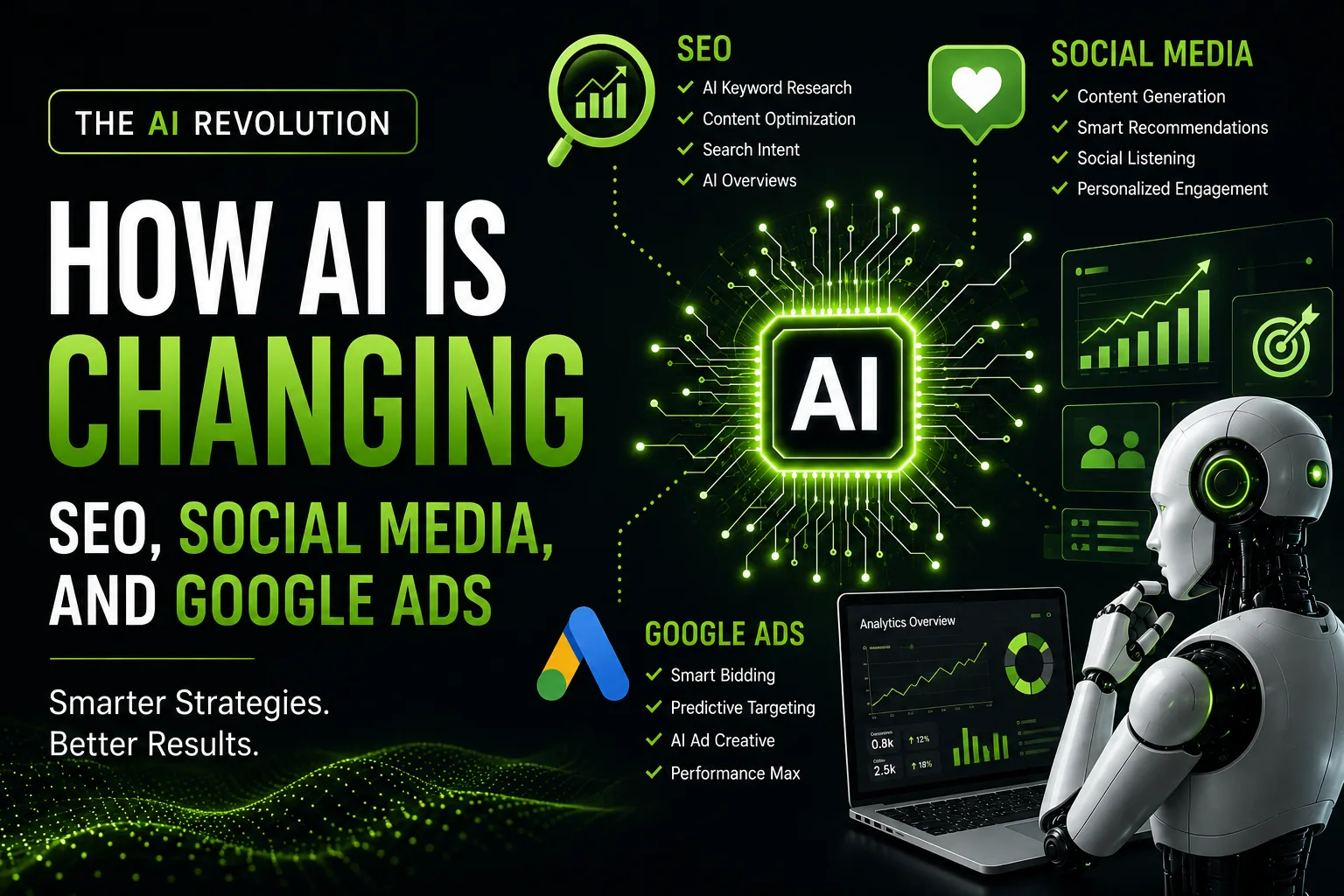
In this article, we'll break down exactly how AI is reshaping three core pillars of digital marketing — SEO, Social Media, and Google Ads — and what this means for anyone learning or working in this field today.
Quick Answer: How Is AI Changing Digital Marketing?
AI is changing digital marketing by automating optimization, personalizing content and ads at scale, and shifting search behavior from traditional "10 blue links" to AI-generated answers. This means marketers must now optimize not just for Google's search algorithm, but also for AI Overviews, chatbots like ChatGPT and Gemini, and generative "answer engines" — Marketers often refer to these emerging practices as Generative Engine Optimization (GEO) and Answer Engine Optimization (AEO). While these are useful industry terms, they should be viewed as extensions of strong SEO fundamentals rather than replacements for SEO.
1. How AI Is Changing SEO
From Keyword Matching to Intent Understanding
Search engines used to rank pages largely by matching keywords. Today, Google's AI system interprets user intent, context, and semantic meaning — not just exact phrases. This is why keyword-stuffed content performs worse than content that genuinely answers a searcher's question.
The Rise of AI Overviews and Zero-Click Search
Google now shows AI-generated summaries directly on the search results page for many queries. This means users often get their answer without clicking a single website. For SEO professionals, this expands the SEO goal beyond traditional rankings to also earning visibility and links within AI-generated search experiences.
What this means for practice:
Structure content with clear, direct answers near the top (like this article does)
Use headers that mirror real user questions
Back claims with data, examples, and clear explanations AI can easily extract and quote
AI-Powered Content Creation and Its Risks
Tools like ChatGPT, Jasper, and Surfer SEO help marketers draft content faster. But Google has been clear: it rewards helpful, original, people-first content, regardless of whether AI assisted in writing it. Mass-produced, generic AI content without human expertise, editing, or real insight tends to get filtered out over time.
Technical SEO Is Now AI-Driven Too
AI now powers:
Automated technical audits (site speed, crawl errors, schema issues)
Predictive keyword research that forecasts ranking difficulty and trend movement
AI-assisted internal linking that identifies content gaps automatically
2. How AI Is Changing Social Media Marketing
Smarter Content Recommendations
Every major platform — Instagram, YouTube, LinkedIn, Facebook — uses AI-driven recommendation engines to decide what content reaches which users. Success on social media increasingly depends on how recommendation systems evaluate signals such as relevance, engagement, watch time, user behavior, and content quality.
AI Content Generation and Design Tools
Marketers now use AI for:
Caption and script generation (ChatGPT, Copy.ai)
Image and video creation (Midjourney, Canva AI, Adobe Firefly)
Video editing and repurposing (Opus Clip, CapCut AI) — turning one long video into multiple short-form clips automatically
This has drastically cut content production time, but it has also raised the bar — audiences now expect faster, more personalized, more visually polished content.
AI-Powered Social Listening and Sentiment Analysis
AI tools can now scan thousands of comments, mentions, and reviews in real time to detect sentiment shifts, brand crises, or emerging trends — something that used to take a human team days to analyze manually.
Hyper-Personalized Customer Interaction
AI chatbots on platforms like Instagram and WhatsApp now handle first-line customer queries, qualify leads, and even recommend products, allowing brands to run 24/7 conversational marketing without a large support team.
3. How AI Is Changing Google Ads
Automated Bidding and Smart Campaigns
Google Ads has shifted heavily toward AI-driven automation:
Smart Bidding (Target CPA, Target ROAS, Maximize Conversions) uses machine learning to adjust bids in real time based on thousands of signals
Performance Max campaigns let Google's AI automatically distribute a single campaign across Search, Display, YouTube, Gmail, and Maps
Responsive Search Ads use AI to test and combine headlines and descriptions to find the best-performing combination automatically
What this means for practice: Media buyers now spend less time manually adjusting bids and more time on strategy, creative quality, audience data, and feeding the algorithm the right signals (like accurate conversion tracking).
AI-Generated Ad Creative
Google's AI can now generate ad copy and even images based on a landing page URL. This speeds up campaign launches but makes human oversight and brand voice control more important than ever — AI-generated ads still need a marketer's judgment to avoid generic or off-brand messaging.
Predictive Audience Targeting
AI-powered Google Ads systems use signals such as search behavior, context, conversion data, audience information, and campaign performance to help identify users who are more likely to take valuable actions.
What This Means for Digital Marketers (and Students) Today
AI hasn't eliminated the need for digital marketers — it has changed what skills matter most. The marketers who will thrive are those who can:
Think strategically, using AI as a tool rather than a replacement for judgment
Write and edit for humans first, while structuring content for AI discoverability
Understand data and analytics well enough to guide AI tools effectively
Stay updated — because AI in marketing is evolving month to month, not year to year
At [Institute Name], our training programs are built around this shift — teaching students not just traditional SEO, social media, and PPC skills, but also how to work alongside AI tools to get better, faster results.
Frequently Asked Questions
Q: Will AI replace digital marketers? No. AI automates repetitive tasks like bidding, reporting, and content drafting, but strategy, creativity, brand judgment, and ethical decision-making still require human marketers.
Q: What is Generative Engine Optimization (GEO)? GEO is the practice of optimizing content so it gets cited or referenced by AI systems like ChatGPT, Google AI Overviews, and Gemini when they generate answers to user queries.
Q: What is Answer Engine Optimization (AEO)? AEO focuses on structuring content — using clear questions, direct answers, and organized headers — so it's easily extracted and featured in search engine answer boxes, voice search results, and AI chat responses.
Q: Do I still need to learn traditional SEO if AI is changing search? Yes. Strong technical SEO, helpful content, clear site structure, internal linking, and overall search visibility remain important because Google's generative search experiences are built on its existing Search systems.
Q: How is AI affecting Google Ads costs? AI-driven automation (like Smart Bidding and Performance Max) has increased overall ad efficiency for many advertisers, but it also means success now depends heavily on the quality of conversion data fed into the system, not just the bid amount.

* Join Techoriz
Ready to master digital marketing?
Learn with Kerala's first ISO-certified agency-based digital marketing academy. Get expert training, live projects, and 95% placement support.
Keep reading
Related Posts
 general
7 Things to Check Before Joining a Digital Marketing Course
Before joining a digital marketing course, you should evaluate seven key factors: the curriculum, trainers' industry experience, practical training, AI integration, internship opportunities, placement support, and student outcomes. A course that balances theory with hands-on experience and keeps pace with industry trends is far more likely to prepare you for a successful career.
November 24, 2026 · Shahala Sherin
Read general
Core Web Vitals in 2026: What Website Owners and Marketers Should Know
Core Web Vitals in 2026 explained — LCP, INP, and CLS thresholds, how Google measures them, what changed, and a practical fix checklist for marketers.
November 24, 2026 · Megha C
Read general
Human Creativity vs AI: What Makes a Great Digital Marketer?
Discover why AI cannot replace digital marketers and how creativity, strategic thinking, and human connection remain essential in the future of digital marketing. Learn how students can combine AI tools with creative skills to build a successful marketing career.
November 24, 2026 · Shahala Sherin
Read