
If you learned Google Ads any time before 2022, you were taught a simple rule: start with exact match, expand carefully to phrase match, and treat broad match like a live grenade. That rule is now mostly obsolete — and if you’re still running your account by it, you’re probably leaving performance on the table.
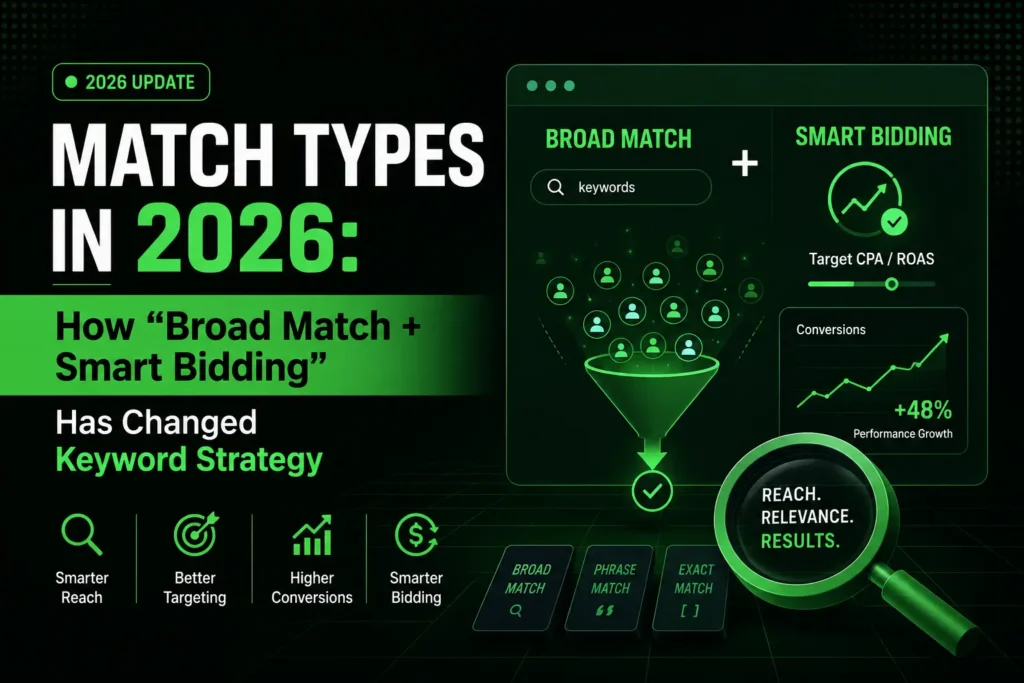
In 2026, the combination of broad match keyword targeting and Smart Bidding has become the default strategy for a large share of high-performing Google Ads accounts. Here’s what changed, why it works differently than it used to, and how to actually manage keyword match type strategy without losing control of your spend.
The traditional logic behind keyword match type was simple: the tighter the match, the more control you had over which searches triggered your ads. Exact match meant precision. Broad match meant reach — and often, wasted spend.
That logic made sense when bidding was manual or rules-based. You picked a bid, Google matched it to a query, and if the match was too loose, you paid for irrelevant clicks with no way to course-correct in real time.
Smart Bidding changed the equation. Google’s bidding algorithms now evaluate dozens of contextual signals — device, location, time of day, past user behavior, auction-time context — and adjust bids for every single auction. This means the algorithm, not the match type alone, is doing the work of deciding whether a query is worth bidding on and how much to pay for it.
In other words: match type used to be your primary control lever. Now it’s one input among several that Smart Bidding uses to find relevant traffic.
Running broad match keywords with a Smart Bidding strategy (like Target ROAS or Maximize Conversions) tells Google: “Here’s my keyword’s core intent — you find the full range of relevant searches, and optimize toward my target outcome, not just topical relevance.”
This works well because:
That said, this is not a “set broad match and walk away” strategy. It requires stricter oversight elsewhere in the account to work safely.
If match type alone isn’t your control lever anymore, where does control shift to? Three places:
Smart Bidding is only as good as the conversion data it’s optimizing toward. If your conversion tracking counts junk leads, low-value form fills, or non-purchase events as “conversions,” broad match will happily go find more of that same low-quality traffic — fast. Before scaling broad match, audit conversion actions and make sure you’re optimizing toward actions that reflect real revenue or qualified leads.
Negative keyword lists become far more important, not less, with broad match. Since the algorithm is casting a wider net, your negative list is the primary guardrail preventing budget waste on adjacent-but-irrelevant searches. Review search term reports weekly, at least during the first 4–6 weeks of a new broad match campaign.
Broad match performs meaningfully better when paired with audience signals — customer match lists, in-market audiences, or website visitor remarketing lists layered as “signals” rather than hard targeting. This gives Smart Bidding a head start on who to prioritize, rather than learning purely from cold data.
In these cases, phrase match still plays a valuable role as a middle ground — giving Smart Bidding room to work while keeping some topical guardrails in place.
Keyword match type hasn’t become irrelevant in 2026 — it’s become a different kind of lever. Instead of using match type to control which searches you show up for, advertisers are using it to control how much room they give Smart Bidding to explore, while shifting real control to conversion data quality, negative keywords, and audience signals.
The accounts winning with broad match aren’t the ones that turned it on and forgot about it. They’re the ones treating it as a strategy that requires more oversight in the right places, not less oversight overall.
At Techoriz Digital Academy, we teach these exact strategies hands-on — from keyword match type selection to Smart Bidding optimization, conversion tracking audits, and full account structuring. Whether you’re a beginner looking to break into digital marketing or a working marketer wanting to sharpen your Google Ads skills, our practical, project-based training is designed to get you job-ready and campaign-ready. Explore our digital marketing courses to learn how to build, manage, and scale Google Ads accounts the way top-performing agencies do.

WhatsApp us