Stepping out of college and into the working world is exciting — and a little overwhelming. One of the first big decisions many beginners face is whether to start with an internship or jump straight into a full-time job. Both paths have real advantages, and the “right” choice depends on your goals, your industry, and where you are in your career journey.
It’s a question that comes up constantly in career forums, campus placement cells, and late-night conversations with friends who are equally unsure about what comes next. Some people swear internships are the only sane way to enter the workforce, while others argue that nothing beats the accountability of a real job. The truth is that both paths can lead to success — they just get you there differently.
Let’s break down the differences to help you decide what makes sense for you.
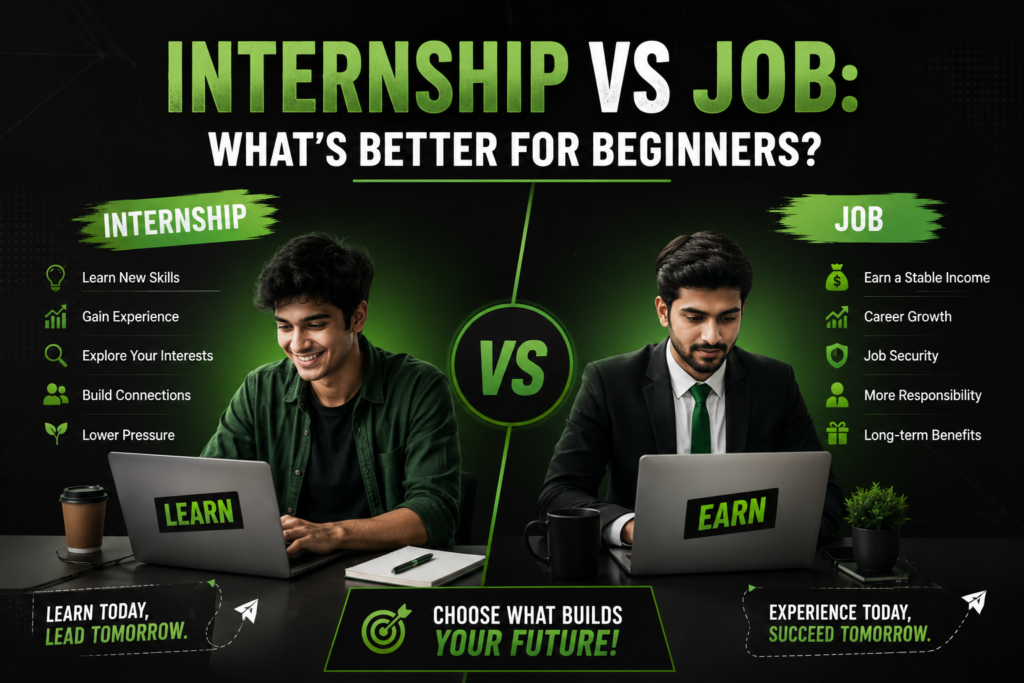
An internship is a short-term, often structured opportunity — usually lasting a few weeks to a few months — designed to give you hands-on experience in a specific field. Internships can be paid or unpaid, and they’re commonly aimed at students or recent graduates who are still exploring their career direction.
Internships are built for learning. Expectations are calibrated to your experience level, so you have room to ask questions, make mistakes, and grow without the same stakes as a full-time role.
You get a genuine feel for how a company operates — its pace, communication style, and values — before committing long-term.
Internships connect you with professionals, mentors, and peers who can become valuable references or contacts later in your career.
Even a short internship adds credibility to your resume and shows employers you’ve had real-world exposure to your field.
You can “test drive” a position or sector through internships.. If it’s not the right fit, you haven’t signed up for years — just a few months.
A full-time job is a longer-term commitment with defined responsibilities, a steady salary, and — usually — benefits like health insurance or paid leave. For beginners, an entry-level job means diving directly into real accountability from day one.
| Factor | Internship | Full-Time Job |
|---|---|---|
| Duration | Short-term (weeks to months) | Long-term / Ongoing |
| Pay | Often lower or unpaid | Regular salary + benefits |
| Learning Curve | Gentle, supportive | Steeper, higher expectations |
| Job Security | Low | Higher |
| Skill Depth | Broad exposure | Deep, focused growth |
| Networking | High potential | Ongoing, but slower to build |
| Risk | Low commitment | Higher commitment |
Yes — quite a bit. In fields like film, journalism, fashion, or design, internships are almost a rite of passage. Portfolios and demonstrated experience often matter more than a diploma, and internships are the standard way to build both. In these industries, skipping the internship route can actually put you at a disadvantage compared to peers who’ve spent time in real studios or newsrooms.
In more structured fields like accounting, engineering, or software development, many companies hire beginners directly into full-time, entry-level roles with formal training programs built in. Here, a job offer straight out of school isn’t unusual, and the “training wheels” period happens on the job rather than through a separate internship.
If you’re unsure which category your field falls into, look at how senior professionals in your industry describe their own early career. If most mention an internship as a turning point, it’s worth prioritizing. If they mostly talk about their first job, that might be the more common — and expected — path.
The honest answer: it depends on your priorities.
Many beginners actually benefit from doing both — starting with one or more internships to explore options and build connections, then transitioning into a full-time role once they’ve found the right fit.
There’s no universally “better” choice between internships and full-time jobs — only what’s better for you, right now. Internships offer a safe space to learn and explore, while full-time jobs offer stability and long-term growth. The smartest move for most beginners is to see internships not as a lesser alternative to a job, but as a stepping stone that makes that first full-time role a much stronger fit.
Wherever you start, the goal is the same: build skills, gain confidence, and move steadily toward the career you want.
If you’re still torn, try asking yourself a few honest questions: Can I afford a lower-paying or unpaid stretch right now? Do I already know what field I want to be in, or am I still exploring? Am I looking for structure and mentorship, or am I ready to be handed real responsibility? Your answers will usually point you toward the right starting move — and remember, this first step doesn’t have to be your last. Careers are rarely linear, and both internships and jobs are simply tools to help you get where you’re going.
For most beginners, an internship is a great starting point because it provides hands-on experience, industry exposure, and mentorship. It helps build practical skills and confidence before taking on the responsibilities of a full-time job.
Yes. Many companies hire interns as full-time employees if they perform well during their internship. Demonstrating strong skills, a positive attitude, and a willingness to learn can significantly increase your chances of receiving a permanent job offer.
If you already have practical skills and a strong portfolio, applying directly for a job can be a good choice. However, if you’re new to the industry and want real-world experience, starting with an internship is often the better option.
Absolutely. Paid internships allow you to earn while learning and gain valuable industry experience. Even if the stipend is lower than a full-time salary, the skills and professional connections you build can lead to better career opportunities in the future.
Internships help beginners develop both technical and soft skills. Depending on the industry, you can learn practical skills like SEO, social media marketing, Google Ads, content writing, data analysis, or web development, while also improving communication, teamwork, problem-solving, and time management.

WhatsApp us