
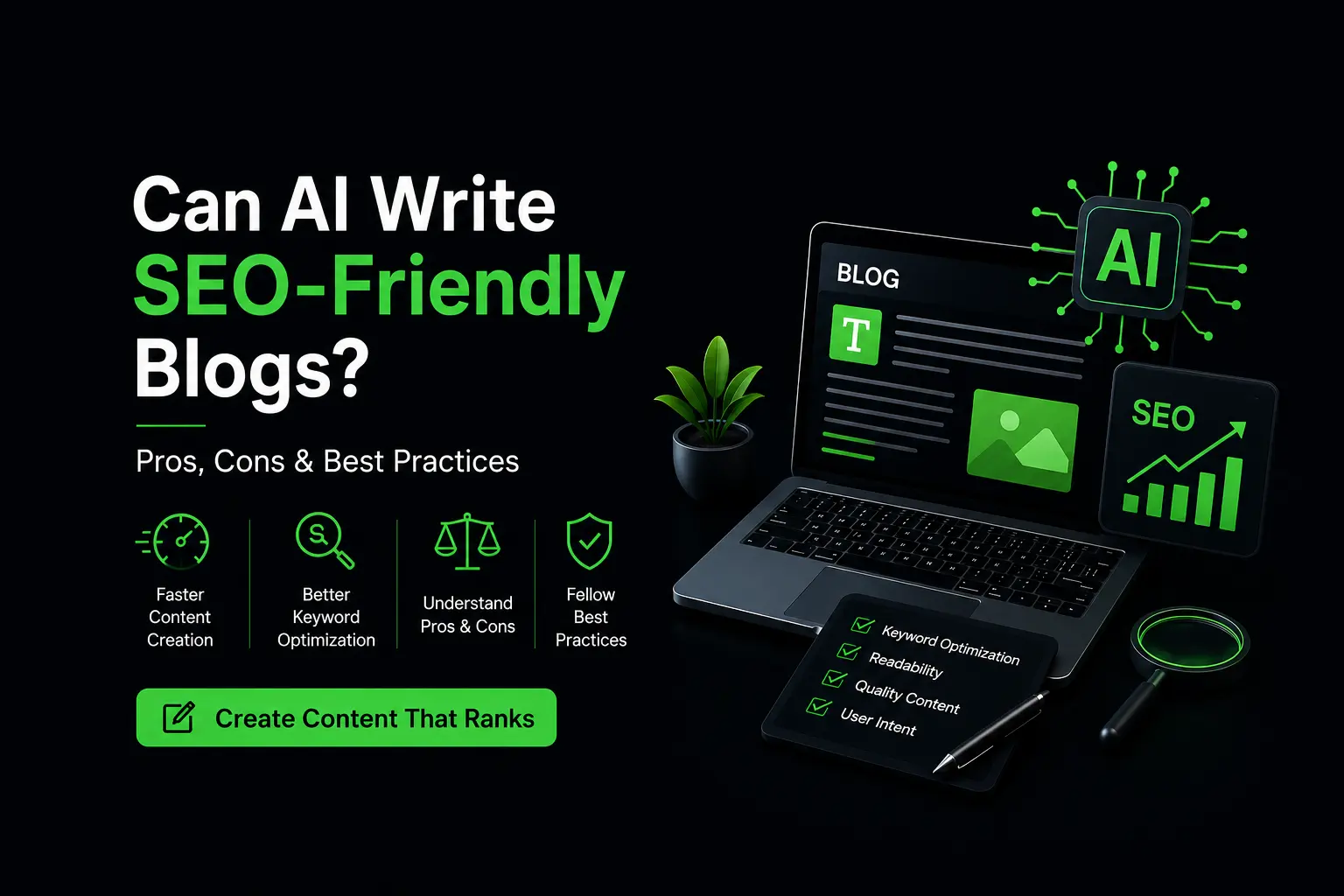
Artificial Intelligence has rapidly transformed content creation. From generating blog outlines to writing complete articles within minutes, AI-powered writing tools have become a valuable resource for marketers, bloggers, and businesses.
But one question still remains:
Can AI write SEO friendly blogs that actually rank on Google?
The answer is yes—but only when used correctly.
AI can speed up content production, improve keyword optimization, and help overcome writer’s block. However, relying entirely on AI without human editing often leads to generic, repetitive, or inaccurate content that struggles to perform in search results.
In this guide, you’ll learn how AI contributes to SEO blogging, where it falls short, and the best practices to create content that both search engines and readers love.
Before discussing AI, it’s important to understand what search engines actually reward.
An SEO-friendly blog typically includes:
Google doesn’t reward content simply because it was written by humans or AI. It rewards helpful, trustworthy, and useful content.
Yes, AI can create SEO friendly blogs—but only as a starting point.
Modern AI writing tools analyze large datasets and understand content structures, keywords, readability, and formatting. They can produce well-organized drafts quickly while following many SEO best practices.
However, AI cannot fully understand:
This is why the best-performing blogs are usually created through a combination of AI efficiency and human expertise.
One of AI’s biggest advantages is speed.
Instead of spending several hours creating the first draft, AI can generate a structured article within minutes.
This allows marketers to:
Most AI writing tools naturally incorporate target keywords throughout the article without excessive repetition.
They help maintain:
This improves the overall SEO structure of the blog.
Every content writer occasionally struggles with finding ideas.
AI can instantly generate:
This provides a strong foundation for creating high-quality articles.
AI generally follows SEO-friendly formatting by using:
Well-structured content improves readability and user experience.
Businesses managing multiple websites or publishing frequent blogs can significantly increase output using AI.
Instead of creating only a few blogs each month, teams can produce more content while maintaining consistency.
AI generates content based on patterns from existing information.
As a result, many AI-written blogs may sound similar to countless articles already available online.
Google values unique perspectives that genuinely help readers.
AI occasionally produces incorrect or outdated information.
Publishing such content without fact-checking can reduce your website’s credibility.
Always verify:
AI often writes in a neutral tone.
Without editing, content may lack:
Readers engage more with authentic human communication.
Although AI understands keywords, it doesn’t always fully understand why users search for certain topics.
For example:
Someone searching for:
“Best Digital Marketing Course”
may actually want:
Only a human writer can fully align content with audience expectations.
While AI doesn’t intentionally copy content, similar prompts often generate similar outputs.
Publishing AI-generated blogs without rewriting or adding unique insights can make your content less competitive.
Let AI handle repetitive tasks like:
Then improve the content manually.
Search engines increasingly reward content with real expertise.
Include:
These elements make your content more trustworthy.
Don’t write only for keywords.
Understand what users truly want when they search.
Answer real questions instead of simply repeating keywords.
Never publish AI-generated content without reviewing it.
Check for:
Human editing makes a significant difference.
Google encourages content that demonstrates:
Whether AI assists or not, your blog should genuinely solve readers’ problems.
Several AI writing tools can support your content creation workflow:
Each tool offers unique strengths, but none should replace human editing entirely.
AI will continue evolving and becoming a standard part of content marketing workflows.
However, search engines are becoming better at evaluating:
The future belongs to creators who use AI as an assistant—not as a replacement for critical thinking and creativity.
So, can AI write SEO friendly blogs?
Absolutely.
AI can help generate ideas, improve productivity, optimize keywords, and create structured content faster than ever before.
However, AI alone isn’t enough to create blogs that consistently rank and engage readers. The most successful SEO content combines AI’s speed with human creativity, expertise, and strategic editing.
If you want blogs that perform well in search results, use AI to simplify the writing process—but let human knowledge shape the final content.
That balance is the key to creating content that ranks higher, builds trust, and delivers lasting value.
Yes. AI-generated blogs can rank if they provide original, helpful, accurate, and user-focused content while following SEO best practices.
No. Google does not penalize content simply because AI helped create it. Low-quality or unhelpful content is what negatively affects rankings.
No. Always review AI-generated content for accuracy, originality, readability, and alignment with your brand voice before publishing.
Popular options include ChatGPT, Jasper AI, Writesonic, Copy.ai, Claude AI, Gemini, and Surfer SEO for optimization.
The biggest advantage is faster content creation, allowing writers and marketers to focus more on strategy, creativity, and audience engagement.

WhatsApp us