Search for a digital marketing institute in Kerala and you will find dozens of websites, each one claiming to be the best, the most affordable, or the most placement-friendly.Almost none of them tell you what actually matters. The glossy homepage and the real classroom experience are often two very different things.
This is not a ranking of institutes. It is a checklist. Read it before you sign up anywhere, including here.
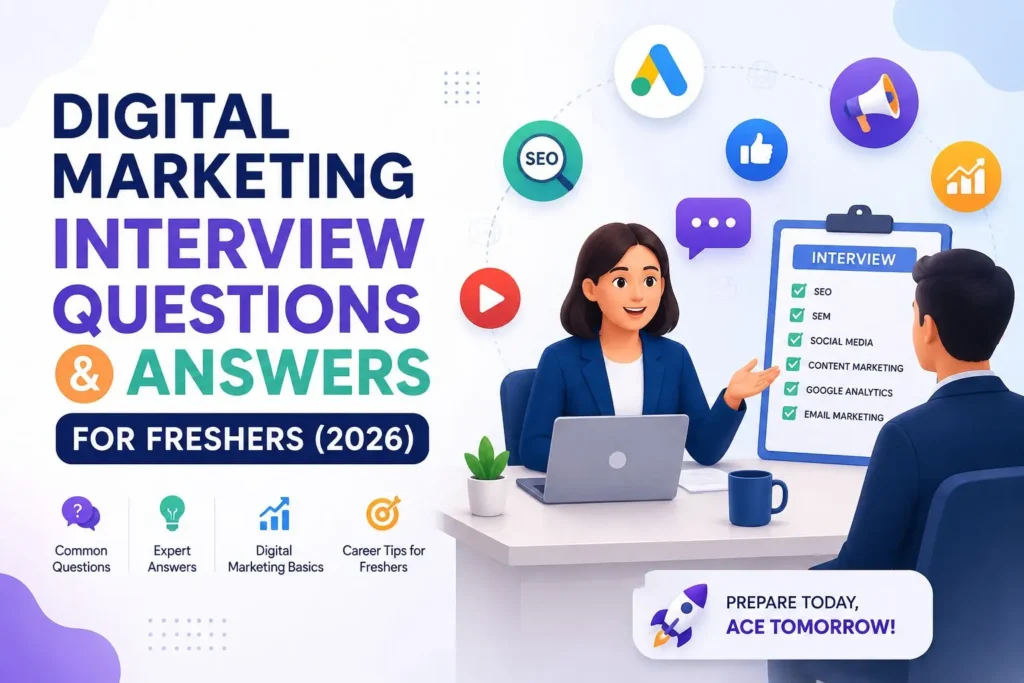
Heading into your first digital marketing interview? This guide covers the most commonly asked digital marketing interview questions and answers for freshers in 2026 — from core concepts like SEO and PPC to practical social media and analytics questions that interviewers love to test. Whether you’re applying for roles in Kerala, Bengaluru, Mumbai, or beyond, these answers will help you walk in confident.
The digital marketing industry in India is growing at an extraordinary pace. According to Statista, India’s digital advertising market is projected to surpass ₹50,000 crore by 2026, creating hundreds of thousands of entry-level and mid-level jobs. For freshers, cracking a digital marketing interview means demonstrating both foundational knowledge and a hunger to learn.At Techoriz Digital Academy, we’ve trained hundreds of students who’ve gone on to land roles at agencies and brands across India. In this post, we’ve compiled the most frequently asked digital marketing interview questions and answers for freshers — structured topic-by-topic so you can prepare systematically
Interviewers almost always begin with foundational digital marketing questions to gauge whether a fresher understands the big picture. Make sure you can answer these with clarity and confidence.
Digital marketing refers to the promotion of products, services, or brands through digital channels — including search engines, social media, email, websites, and mobile apps. Unlike traditional marketing (print ads, billboards, TV), digital marketing allows for precise targeting, real-time tracking, and two-way communication with the audience.
Key differences include: measurability (you can track every click and conversion), cost-effectiveness (lower entry cost vs. TV or print), targeting (reach specific demographics, interests, and locations), and speed (campaigns can go live within hours).
Mention a real example — “A Facebook Ad for a local clothing brand in Kannur can specifically target 18–30 year olds interested in streetwear in Maharashtra.”
The core channels of digital marketing include:
1. SEO – Optimizing websites to rank on search engines like Google.
2. SEM / PPC – Paid advertising via Google Ads and Bing Ads.
3. Social Media Marketing – Organic and paid promotion on Instagram, Facebook, LinkedIn, YouTube, etc.
4. Content Marketing – Blogs, videos, infographics, and podcasts to attract and engage audiences.
5. Email Marketing – Newsletters, drip campaigns, and promotional emails.
6. Affiliate Marketing – Commission-based promotion through affiliate partners.
7. Influencer Marketing – Collaborating with content creators to promote brands.
8. Analytics & Data – Using tools like Google Analytics to measure and optimize performance.
A digital marketing funnel is a model that maps a customer’s journey from awareness to purchase (and beyond). The classic funnel has four stages:
1. Awareness (TOFU – Top of Funnel): The customer learns about your brand for the first time through ads, social media, or blog posts.
2. Interest / Consideration (MOFU – Middle of Funnel): They engage with your content, compare options, and read reviews.
3. Conversion (BOFU – Bottom of Funnel): They take action — make a purchase, fill a form, or send a DM.
4. Retention & Advocacy: Post-purchase email sequences, loyalty programs, and referral campaigns keep the customer coming back.
Learn more about marketing funnels in ourdigital marketing blog
Inbound marketing attracts customers by creating valuable content that pulls them toward you — blog posts, SEO, social media, and webinars. The customer comes to you.
Outbound marketing pushes messages to a broad audience regardless of interest — cold emails, display ads, TV commercials. You go to the customer.
In 2026, a strong digital strategy typically blends both: SEO and content for inbound, and Google Ads + Meta Ads for targeted outbound.
SEO (Search Engine Optimization) questions are among the most common in any digital marketing interview. Even if you’re applying for a social media or content role, interviewers expect you to know the fundamentals. Study the Google Search documentation and stay updated on algorithm changes.
SEO (Search Engine Optimization) is the practice of optimizing a website to rank higher on search engine results pages (SERPs) for relevant keywords — without paying for placement. It’s important because:
• Over 68% of online experiences begin with a search engine (BrightEdge, 2024).
• Organic traffic is free and sustainable compared to paid ads.
• High-ranking pages build trust and credibility with users.
• It delivers long-term ROI even after you stop actively working on it.
On-Page SEO: Optimizing elements within your own website — title tags, meta descriptions, headers (H1, H2), keyword placement, internal linking, image alt text, and content quality.
Off-Page SEO: Building authority through external signals — backlinks from reputable websites, brand mentions, social signals, and guest posts.
Technical SEO: Ensuring search engine bots can crawl and index your site efficiently — site speed, mobile-friendliness, XML sitemaps, structured data (schema markup), SSL/HTTPS, and fixing broken links.
Use tools like Google Search Console and Ahrefs or Moz for SEO audits.
Keyword research is the process of finding and analyzing the search terms that people enter into search engines, with the goal of using that data for SEO and content marketing. It helps you understand what your target audience is searching for.
Popular keyword research tools include:
• Google Keyword Planner – Free, great for volume data.
• Ubersuggest – Beginner-friendly and free tier available.
• Ahrefs Keywords Explorer – Industry-standard for competitive research.
• SEMrush – All-in-one marketing toolkit with keyword features.
• Google Search Console – Shows what queries already bring traffic to your site.
A backlink (or inbound link) is a hyperlink from another website pointing to your website. Search engines like Google treat backlinks as “votes of confidence” — if a reputable site links to you, it signals that your content is trustworthy and valuable.
Why they matter: Backlinks are one of Google’s top ranking factors. Websites with a strong backlink profile consistently outrank those without. However, quality matters more than quantity — a single link from a high-DA (Domain Authority) site like The Hindu or Economic Times is worth far more than 100 links from low-quality directories.
Domain Authority (DA) is a metric developed by Moz that predicts how likely a website is to rank on search engines, scored on a scale of 1–100. A higher DA means more ranking power.
Page Authority (PA) is similar but measures the ranking strength of a specific page rather than the entire domain.
Both are useful benchmarks for comparing websites and evaluating link-building opportunities, though they are third-party metrics — not official Google ranking signals.
SEM (Search Engine Marketing) questions test your understanding of paid advertising. Interviewers for roles that involve running Google Ads or PPC campaigns will dig deep here.
PPC (Pay-Per-Click) is a form of online advertising where advertisers pay a fee each time their ad is clicked. Google Ads is the world’s largest PPC platform.
How Google Ads works:
1. Advertisers choose keywords they want to target.
2. When a user searches for that keyword, an auction takes place in real time.
3. Google considers each advertiser’s bid amount and Quality Score (relevance of ad, landing page, and expected CTR).
4. The ad with the highest Ad Rank (Bid × Quality Score) wins the top position.
5. The advertiser pays only when someone clicks the ad.
Ad Rank = Bid × Quality Score. A high Quality Score lets you rank higher while paying less per click.
Quality Score is Google’s rating (1–10) of the relevance and quality of your keywords, ads, and landing pages. A higher Quality Score means lower CPCs and better ad positions.
It is determined by three factors:
1. Expected CTR: How likely users are to click your ad for a given keyword.
2. Ad Relevance: How closely your ad copy matches the search intent.
3. Landing Page Experience: Whether your landing page is useful, relevant, and fast-loading.
CPC (Cost Per Click): You pay each time someone clicks your ad. Best for driving website traffic.
CPM (Cost Per Mille / Cost Per 1000 Impressions): You pay for every 1,000 times your ad is shown, regardless of clicks. Best for brand awareness campaigns.
CPA (Cost Per Acquisition): You pay only when a specific action is completed — a purchase, form submission, or app install. Best for performance-focused campaigns.
Social media marketing questions are increasingly a major part of digital marketing interviews in 2026, especially for roles involving Instagram, Facebook, LinkedIn, and YouTube. Refer to Meta Business Suite and stay current with platform updates.
Social media marketing (SMM) is the use of social media platforms to connect with your audience, build your brand, drive traffic, and generate leads or sales.
Key benefits include:
• Brand awareness: Reach millions of users organically or through paid ads.
• Audience engagement: Build direct relationships through comments, DMs, and stories.
• Cost-effective advertising: Meta Ads can reach highly targeted audiences with small budgets.
• Traffic generation: Drive users to your website, landing page, or WhatsApp.
• Insights: Real-time analytics to measure what’s working.
Organic reach refers to how many people see your content for free — through your followers, shares, and the platform’s algorithm. Since 2018, organic reach on Facebook and Instagram has declined significantly due to algorithm changes.
Paid reach refers to the audience you reach by running paid advertisements (Meta Ads, boosted posts). Paid reach allows you to target specific demographics, interests, behaviors, and locations — far beyond your organic follower base.
A winning strategy combines strong organic content (builds trust) with targeted paid ads (scales reach) — especially important for e-commerce and local businesses in India.
Key Performance Indicators (KPIs) for SMM include:
• Reach: Total unique accounts who saw your content.
• Impressions: Total times your content was displayed (one person can create multiple impressions).
• Engagement Rate: (Likes + Comments + Shares + Saves) / Reach × 100.
• Follower Growth Rate: Speed at which your audience is growing.
• CTR (Click-Through Rate): % of people who clicked a link in your post or ad.
• Conversions: Sales, leads, or DMs generated from social campaigns.
• ROAS (Return on Ad Spend): Revenue ÷ Ad Spend.
A content calendar (or social media calendar) is a planning document that schedules what content will be published, on which platform, on what date, and by whom.
Importance:
• Ensures consistent posting — crucial for algorithm visibility.
• Allows strategic planning around festivals, product launches, and campaigns.
• Helps teams collaborate efficiently across content creation, design, and approval.
• Reduces last-minute scramble and keeps brand messaging cohesive.
Content is still king in 2026. Whether you’re interviewing for a content writing, content strategy, or digital marketing executive role, expect questions on content marketing fundamentals. Resources like Content Marketing Institute are great for staying current.
Content marketing is a strategy focused on creating and distributing valuable, relevant, and consistent content to attract and retain a clearly defined audience — and ultimately drive profitable customer action.
Unlike traditional advertising (which interrupts), content marketing attracts customers by solving their problems or entertaining them. Examples include blog posts, YouTube videos, Instagram Reels, podcasts, case studies, and infographics.
A blog post is an informational or educational piece of content designed to attract organic traffic, build authority, and engage readers. It typically ranks on Google for specific keywords and drives top-of-funnel awareness.
A landing page is a focused, standalone web page designed with a single goal: to convert visitors into leads or customers. It has minimal navigation, a clear CTA (Call-to-Action), and is often used in ad campaigns.
A CTA (Call-to-Action) is a prompt that tells the user what action to take next — “Buy Now,” “Download Free Guide,” “DM Us on Instagram,” “Get a Free Demo.”
Tips for an effective CTA:
• Use action-oriented verbs: Start, Get, Claim, Download, Join.
• Create urgency or value: “Limited Offer – Enroll Today.”
• Be specific: “Download the 2026 SEO Checklist” beats “Click Here.”
• Position it prominently — above the fold on landing pages, and at the end of blog posts.
Email marketing is the practice of sending targeted messages to a list of subscribers via email to nurture leads, promote products, share updates, or build relationships.
Advantages:
• Highest ROI of any digital channel — approximately ₹3,600 return for every ₹100 spent (DMA, 2024).
• Direct access to your audience without algorithm dependency.
• Highly personalizable and automatable with tools like Mailchimp, ConvertKit, or Klaviyo.
• Measurable — open rates, CTR, and conversions are tracked in real time.
Open Rate: The percentage of recipients who opened your email. Formula: (Emails Opened / Emails Delivered) × 100.
Click-Through Rate (CTR): The percentage who clicked at least one link in the email. Formula: (Clicks / Emails Delivered) × 100.
Industry benchmarks (2025–26):
• Average open rate: 20–30% (varies by industry).
• Average CTR: 2–5%.
Subject line, sender name, send time, and list hygiene are the four biggest levers for improving open rates.
A drip campaign (also called an automated email sequence) is a series of pre-written emails that are sent automatically based on a trigger or schedule — for example, a welcome series sent to new subscribers over 5 days.
Drip campaigns are used for: onboarding new users, nurturing leads, abandoned cart recovery, re-engagement, and post-purchase follow-ups. They save time while keeping leads warm.
Every digital marketer must be data-driven. Analytics questions test whether you can not just run campaigns, but understand and improve them. Get comfortable with Google Analytics 4 (GA4).
Google Analytics 4 (GA4) is a free web analytics platform by Google that tracks and reports website traffic and user behavior. It helps marketers understand:
• Traffic sources: Organic, direct, social, paid, referral.
• User behavior: Pages visited, session duration, bounce rate.
• Conversions: Goal completions, purchases, form fills.
• Audience demographics: Age, gender, location, device.
Freshers should learn to read key reports: Acquisition, Engagement, Monetization, and Retention.
Bounce rate is the percentage of sessions where a user lands on a page and leaves without taking any further action (visiting another page, clicking a CTA, etc.).
A high bounce rate is not always bad. For example:
• A blog post where users read the article and leave has a “high bounce rate” but served its purpose.
• A contact page where users find a phone number and call has a high bounce rate but a successful conversion.
It’s bad when it indicates poor user experience, irrelevant traffic, slow loading speed, or a mismatch between ad promise and landing page content.
ROI (Return on Investment) measures the profit generated by your marketing efforts relative to how much you spent.
Formula: ROI = (Revenue from Campaign – Cost of Campaign) / Cost of Campaign × 100
Example: If you spent ₹10,000 on a Meta Ads campaign and it generated ₹40,000 in sales:
ROI = (40,000 – 10,000) / 10,000 × 100 = 300% ROI
Related metric: ROAS (Return on Ad Spend) = Revenue / Ad Spend. If ROAS = 4, you earn ₹4 for every ₹1 spent.
A/B testing (or split testing) is the process of comparing two versions of a marketing element — an email subject line, ad creative, landing page headline, or CTA button — to see which performs better.
How it works:
1. Define a hypothesis: “Version B headline will increase CTR.”
2. Split your audience 50/50 and show Version A to one group, Version B to the other.
3. Run the test until statistical significance is reached.
4. Adopt the winning version and test the next element.
A/B testing is the backbone of Conversion Rate Optimization (CRO).
Common analytics tools for digital marketers include:
• Google Analytics 4 – Website traffic and user behavior.
• Google Search Console – SEO performance and keyword impressions.
• Meta Ads Manager – Facebook & Instagram ad performance.
• Hotjar / Microsoft Clarity – Heatmaps and session recordings.
• SEMrush / Ahrefs – SEO and competitor analysis.
• Mailchimp / Klaviyo – Email campaign analytics.
• Google Data Studio (Looker Studio) – Custom dashboards combining multiple data sources.
CTR (Click-Through Rate) is the ratio of users who click on a link compared to the total who saw it. Formula: (Clicks / Impressions) × 100.
Ways to improve CTR:
• Write compelling ad copy with clear benefits and urgency.
• Use power words: Free, Exclusive, New, Proven, Limited.
• Match ad to landing page: The page must deliver what the ad promises.
• Test different visuals and formats (Reels vs. Static images).
• Use ad extensions in Google Ads (site links, callouts, location extensions).
Influencer marketing involves collaborating with individuals who have an established audience on social media or YouTube to promote a brand’s products or services.
Brands choose influencers based on:
• Niche relevance (fitness influencer for gym supplements)
• Audience demographics (age, location, interests matching the target customer)
• Engagement rate (high engagement > high follower count)
• Authenticity and brand alignment
Types: Mega (>1M), Macro (100K–1M), Micro (10K–100K), Nano (<10K). Micro and nano influencers often deliver better engagement and ROI for niche products.
Remarketing (or retargeting) is the practice of showing ads to people who have previously visited your website, engaged with your app, or interacted with your social media — but haven’t converted yet.
It works by placing a tracking pixel (e.g., Meta Pixel or Google Tag) on your website that records visitor data. You then serve targeted ads to this warm audience across platforms.
Remarketing is highly effective because you’re reaching people who already know your brand, making them 70% more likely to convert than cold traffic.
Knowing the answers is only half the battle. How you present yourself and your knowledge makes just as much of a difference. Here are key preparation tips from the trainers at Techoriz Digital Academy:
Join Techoriz Digital Academy’s Advanced Digital Marketing Program in Kozhikode or Kannur — with live projects, mentorship, and placement support.
Start by learning the fundamentals: SEO, SEM, social media marketing, content marketing, email marketing, and analytics. Get certified through free platforms like Google Skillshop and HubSpot Academy. Build a small portfolio — even a personal project like growing an Instagram page or writing SEO blog posts counts. Research the company, know their digital presence, and practice answering questions aloud.
Entry-level digital marketing salaries in India typically range from ₹2 LPA to ₹4.5 LPA depending on the city, company, and specialization. Freshers with certification, portfolio projects, and hands-on training (like our students at Techoriz) often land higher starting salaries. Metros like Bengaluru, Mumbai, and Hyderabad pay more; Kerala-based agencies are growing rapidly as well.
This guide covers the most important digital marketing interview questions and answers for freshers in 2026. Bookmark this page, practice your answers, and walk into your interview with confidence. If you’re looking to fast-track your learning with live mentorship and real campaign experience, explore our programs at Techoriz Digital Academy — Kerala’s leading digital marketing training institute.

WhatsApp us