
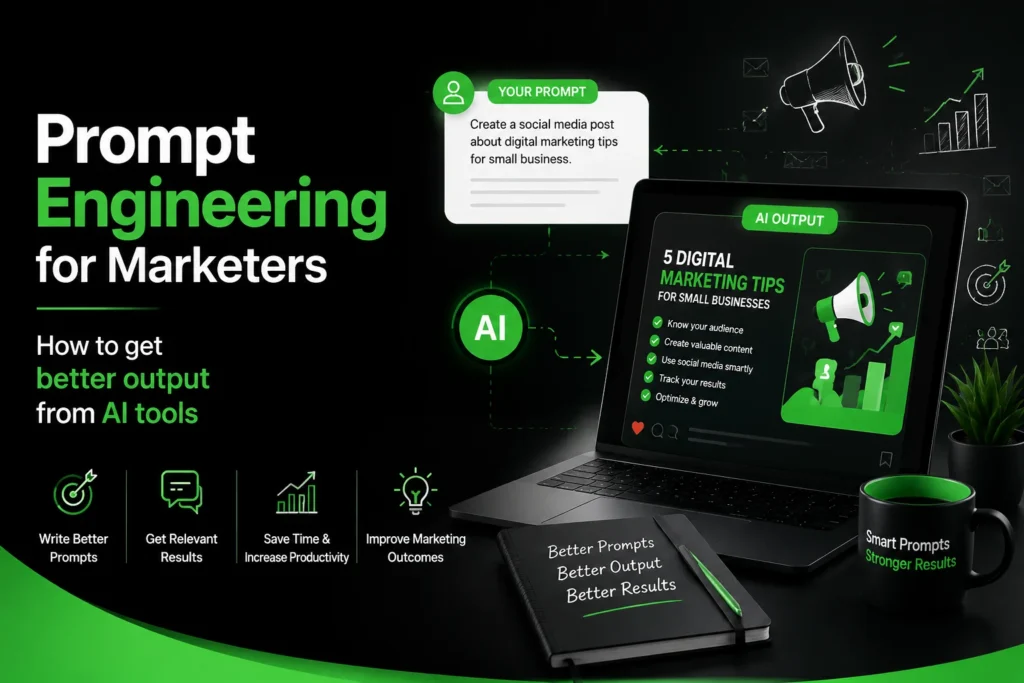
Two marketers open ChatGPT at the same time. Same tool, same subscription, same brand brief.One gets a generic, forgettable paragraph that sounds like every other brand on the internet. The other gets a sharp, on-brand draft that needs barely any editing.
The difference was never the tool. It was the prompt.
Prompt engineering sounds like a technical term reserved for developers, but in 2026, it has quietly become one of the most valuable skills a marketer can have. It is not about coding. It is about communicating clearly enough that an AI tool understands exactly what you want — the first time, not the fifth.This guide breaks down exactly how to do that, with real prompt examples you can use today.
Every marketer now has access to the same AI tools. ChatGPT, Claude, Gemini — the playing field has never been more level on paper.So what separates a marketer whose AI-assisted content actually performs from one whose output gets ignored? The instructions they give.
of marketers already use AI daily
faster output with a clear prompt
AI skill employers now ask for
A vague prompt gives the AI room to guess. And when AI guesses, it defaults to the most generic, average version of an answer — which is exactly why so much AI content sounds the same. A specific prompt removes the guesswork and forces the output toward what you actually need.
Every strong marketing prompt has five ingredients. Miss one, and the output gets noticeably weaker. Here is a simple framework to remember them:
Tell the AI who you are, who the audience is, and what the situation is. Without context, the AI has nothing to anchor the tone or content to.
Example: “You are writing for a digital marketing institute in Kerala targeting +2 students and their parents.”
Assign the AI a specific role or persona. This single line changes the vocabulary, tone, and depth of the response more than almost anything else.
Example: “Act as a senior content strategist who writes in a warm, conversational tone — never corporate or stiff.”
Be precise about the actual task. Not “write something about SEO” but exactly what format, what angle, and what it should achieve.
Example: “Write a 150-word Instagram caption announcing a new batch, with a clear CTA to message on WhatsApp.”
Specify the structure you want back. Bullet points? A table? Short paragraphs? Word count? AI tools follow formatting instructions closely when you state them clearly.
Example: “Keep it under 100 words, no headings, write it as three short punchy lines.”
This is where you eliminate the parts of AI writing everyone recognizes instantly — the em dashes, the overly formal transitions, the “in today’s fast-paced world” openers.
Example: “Avoid corporate buzzwords. Do not use the phrase ‘game changer’ or ‘unlock your potential.’ Write the way a helpful friend would explain it.”
The fastest way to understand prompt engineering is to see it side by side. Here are three common marketing tasks, written both ways:
Example 1: Social media caption
“Write an Instagram caption for our digital marketing course.” |
“Write a 60-word Instagram caption for a digital marketing diploma |
Example 2: Blog introduction
“Write an intro for a blog about SEO trends.”
“Write a 100-word blog intro for SEO professionals in Kerala who already |
Example 3: Client email
“Write a follow-up email to a client.”
“Write a short follow-up email to a restaurant client who hasn’t replied in 5 days about our Meta Ads proposal. Friendly, not pushy. One specific question they can answer in one line. Sign off as Shirin from Techoriz.”
Pro Tip: Notice the strong prompts never use the word ‘good’ or ‘better.’ They use numbers, names, audiences, and constraints instead — specifics the AI can act on.
Copy, customise, and use these directly. Each one is built using the C.R.A.F.T. framework above.
“Act as a social media strategist for a digital marketing institute. Create a 7-day Instagram content calendar for next week, mixing student success tips, course information, and one trending Reel idea. Keep each day’s idea to one line.”
“Write 3 meta description options for a blog titled ‘[your blog title]’. Each must be under 155 characters, include the keyword ‘[your keyword]’, and end with a soft call to action.”
“Write 4 different Facebook ad primary text variations for [product/course], each under 125 characters, each testing a different angle: urgency, curiosity, social proof, and direct offer.”
“Explain [topic] the way you would to a smart 16-year-old who has never heard the term before. No jargon. Use one relatable analogy.”
“Rewrite this paragraph so it sounds like a real person typed it, not AI. Remove em dashes, remove the word ‘unlock,’ shorten the sentences, and make it sound conversational: [paste your text]”
Watch out: If your AI output keeps sounding generic, the problem is almost never the tool — it’s that the prompt never specified an audience, a tone, or a constraint.
If you are writing for a Kerala audience, add a line like this to your prompts: “Write for an audience in Kozhikode/Kannur who relates to local references, not generic Indian examples.”
This single instruction stops AI from defaulting to generic, pan-India phrasing and pushes it toward content that actually feels local — which matters far more than people realise when it comes to engagement.
Prompt engineering is a skill you build by doing — writing real captions, real ad copy, and real client emails, then refining based on what actually works.
At Techoriz Digital Academy, our AI-Integrated Strategic Digital Marketing courses teach exactly this — practical AI tool usage alongside SEO, Meta Ads, and content strategy, with live client projects.
AI tools are not getting smarter at reading your mind. They are getting better at following clear instructions.
That is the whole game. The marketers who win with AI in 2026 are not the ones with access to better tools — everyone has access to the same tools now. They are the ones who have learned to ask for exactly what they need.Start with the C.R.A.F.T. framework on your next prompt. Add context, assign a role, be specific about the action and format, and state your tone clearly. You will notice the difference in the very first response.

WhatsApp us